

There’s a kind of sadness that doesn’t announce itself loudly.
It doesn’t always come with tears or a clear reason. It just settles in—quietly, steadily—and doesn’t leave when you expect it to.
You might still be going to work. Still answering messages. Still showing up.
But underneath that… something feels heavy.
If you’ve found yourself wondering whether something like EMDR could help—or questioning if it’s “only for trauma”—you’re not overthinking it. You’re noticing something important.
You can start exploring support like therapy for persistent sadness without needing to have a perfect explanation first.
When the Feeling Doesn’t Match Your Life
One of the most confusing parts about this kind of sadness is that it doesn’t always match what’s happening around you.
On paper, things might look okay.
Nothing major is wrong.
Nothing obvious explains why you feel this way.
And that can make it harder—not easier.
Because you start asking yourself:
- “Why do I feel like this?”
- “Shouldn’t I be okay?”
- “Am I just overreacting?”
But emotions don’t always follow logic.
Sometimes your internal world needs attention, even when your external world looks stable.
The Subtle Signs Something Deeper Is Going On
This kind of sadness often shows up in ways that are easy to dismiss at first.
You might notice:
- A lack of motivation, even for things you used to enjoy
- Feeling emotionally flat or disconnected
- Getting through the day but not really feeling it
- A quiet sense of heaviness that doesn’t fully lift
It’s not always intense.
It’s consistent.
And over time, that consistency can wear you down.
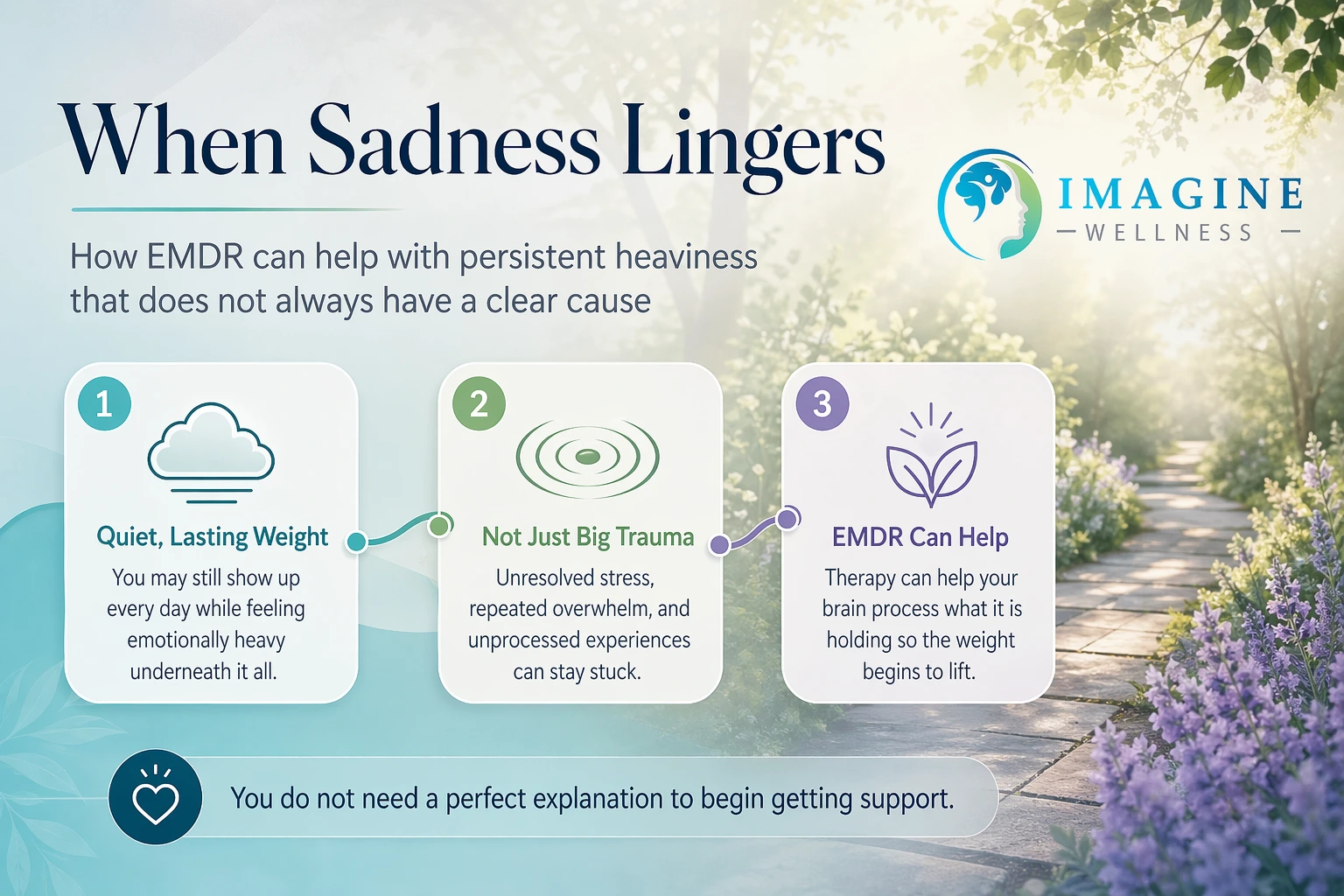
It Doesn’t Have to Be “Big Trauma” to Matter
A lot of people assume therapies like EMDR are only for very specific, intense experiences.
And yes—it’s often used for trauma.
But here’s what’s important:
Not all emotional pain comes from one clear, defining moment.
Sometimes it comes from:
- Long periods of stress that never fully resolved
- Repeated experiences that felt overwhelming at the time
- Emotional moments that didn’t get processed or supported
Your brain doesn’t always categorize experiences as “big enough” or “not big enough.”
If something affected you, your system remembers it.
And sometimes, it holds onto it longer than you expect.
Why Sadness Can Feel Like It Won’t Move
You might have tried to shift it.
Distracting yourself.
Staying busy.
Talking yourself through it.
And still—it lingers.
That’s often because the part of your brain responsible for processing emotional experiences hasn’t completed what it started.
So instead of moving through the feeling, it gets stuck in a loop.
Not because you’re doing anything wrong.
But because your system needs a different kind of help to process what it’s holding.
Where EMDR Can Actually Help
EMDR isn’t just about revisiting the past.
At its core, it’s about helping your brain process experiences that feel unresolved.
That can include:
- Clear memories you can point to
- Emotional patterns you don’t fully understand
- Or even that persistent sadness that doesn’t seem to have a single cause
Some people begin EMDR thinking, “I don’t even know what I’d talk about.”
And that’s okay.
You don’t need a perfectly defined story to begin exploring what your mind and body might be holding onto.
You Don’t Need to “Prove” That You’re Struggling Enough
This is one of the biggest barriers people face.
They wait.
They minimize.
They tell themselves:
- “Other people have it worse.”
- “This isn’t serious enough.”
- “I should be able to handle this.”
But support isn’t something you earn by reaching a certain level of pain.
It’s something you allow yourself when you notice you’re struggling.
Even quietly.
Even privately.
Even without a clear reason.
What It Feels Like When Something Starts to Shift
Progress in this kind of work isn’t always dramatic.
Sometimes it shows up in small, meaningful ways:
- You feel a little lighter waking up
- Certain thoughts don’t hit as hard
- You have moments where you feel more like yourself
It’s not about forcing happiness.
It’s about reducing the weight that’s been sitting on top of everything.
Over time, that creates space.
You Can Move at Your Own Pace
If part of you feels unsure, that’s okay.
You don’t have to rush into anything.
You can:
- Ask questions
- Learn more about your options
- Take one step at a time
Starting doesn’t mean committing to everything at once.
It just means being open to the idea that you don’t have to stay stuck in this feeling.
You’re Not Alone in This Experience
Even though it can feel isolating, this kind of sadness is more common than people talk about.
A lot of individuals experience periods where:
- Their emotions feel heavier than expected
- Their energy drops without a clear reason
- Their usual coping strategies stop working
And many of them hesitate to reach out—because it doesn’t feel “serious enough.”
But that doesn’t make it less real.
FAQs: Questions You Might Be Sitting With
Is EMDR only for trauma?
No. While EMDR is widely known for trauma work, it’s also used to help process other emotional experiences that feel stuck or unresolved—including persistent sadness.
What if I don’t have a specific memory to focus on?
That’s okay. You don’t need one clear event. Many people start with general feelings, patterns, or emotional states.
Can this really help if I don’t know why I feel this way?
Yes. You don’t have to fully understand the “why” before starting. Sometimes the process itself helps uncover and resolve what’s underneath.
What if I’m nervous to try something new?
That’s completely normal. Starting anything unfamiliar can feel uncertain. You’re allowed to go at your own pace and ask questions along the way.
How long does it take to feel a difference?
It varies. Some people notice shifts early, while others experience gradual changes over time. What matters most is consistency and feeling supported.
Do I have to talk about everything in detail?
Not necessarily. EMDR doesn’t always require you to explain every detail of an experience. The process is designed to work with how your brain stores and processes information.
You Don’t Have to Keep Waiting for It to Lift
If this sadness has been lingering—if it’s been quietly shaping your days and you’re starting to wonder if it’s more than just a phase—you don’t have to figure it out alone.
There are ways to explore what’s underneath it, gently and without pressure.
And you don’t need a perfect explanation to begin.
If you’re in Peach Tree, Georgia, and thinking about your next step, support is available in a way that meets you where you are.
Call 678-736-8983 to learn more about our conditions, depression services in Peach Tree, Georgia.