

There’s a specific kind of quiet panic that hits when something you thought you had handled… comes back.
Not all at once. Not dramatically.
Just enough to make you notice.
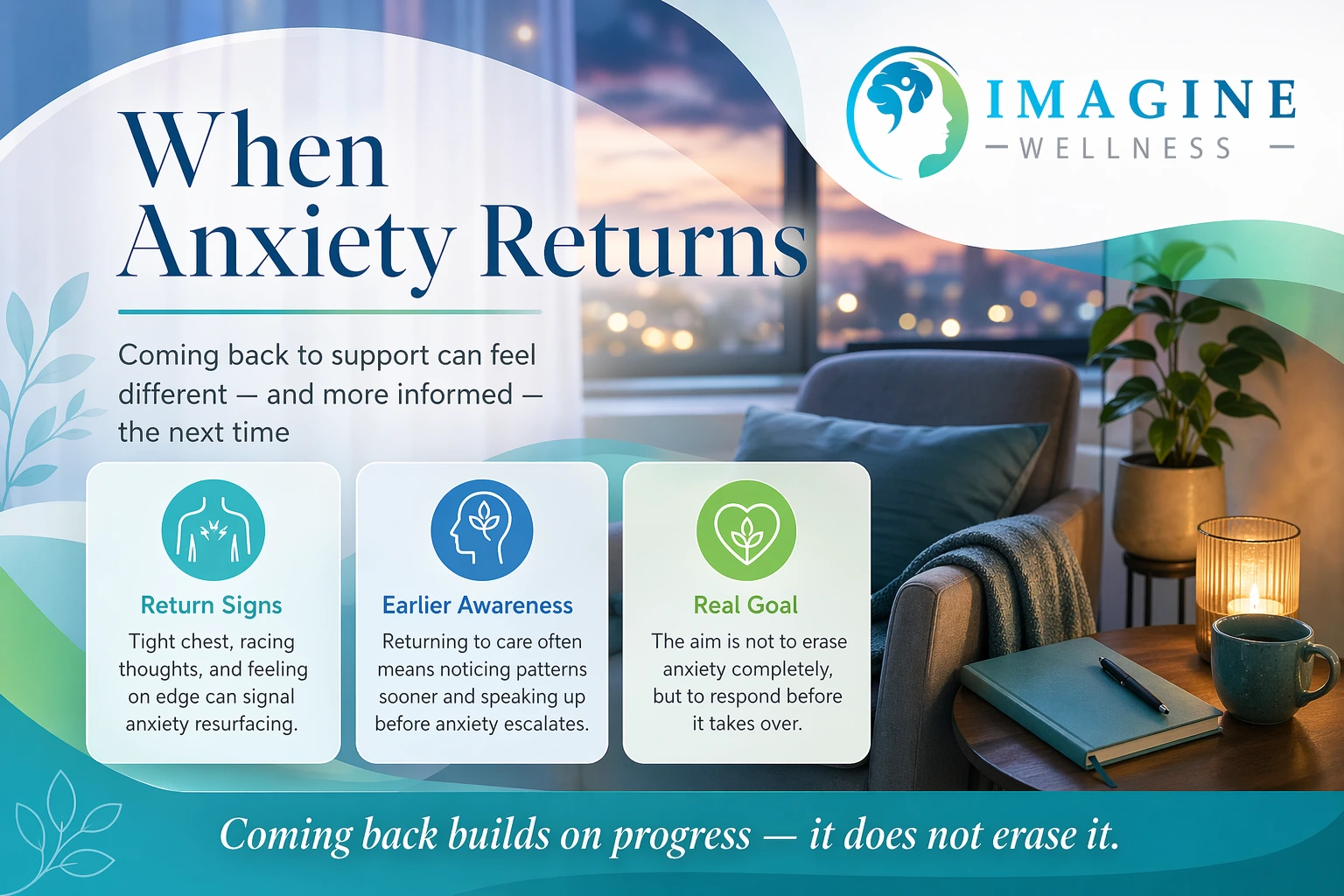
You’re driving. Sitting in a meeting. Lying in bed. And there it is again—that familiar edge. The tight chest. The racing thoughts. The feeling that something isn’t right, even when everything looks fine.
If you’ve found yourself searching for something like the “best therapist in Atlanta for constant worry and panic attacks,” it’s probably not about finding the best.
It’s about finding something that actually holds this time.
You can begin again with support like anxiety-focused care without needing to explain how you got back here.
When It Comes Back, It Feels Like You Lost Something
Most people don’t talk about this part.
They talk about starting. They talk about getting better.
They don’t talk about what it feels like when symptoms return after you’ve already done the work.
It can feel like you lost ground.
Like something slipped through your hands.
You might think:
- “I was doing so well.”
- “I should’ve been able to maintain this.”
- “Did I mess it up somehow?”
There’s a quiet kind of grief in that.
Not just about the anxiety—but about the version of you that felt more stable.
But here’s the truth that often gets missed:
You didn’t lose everything.
You’re feeling something that needs attention again.
That’s not the same as starting over.
The Panic Feels Louder the Second Time
The first time, panic feels confusing.
The second time, it feels… personal.
Because now you recognize it.
You know what it can turn into.
You know how much space it can take up if it grows.
And that awareness can make it feel louder, faster.
It’s not just:
“This feels uncomfortable.”
It’s:
“I know where this goes, and I don’t want to go back there.”
That urgency can create even more tension.
And that tension can feed the cycle.
You Didn’t Fail—You Hit a Layer You Haven’t Worked Through Yet
It’s easy to label this as failure.
But most of the time, it’s not.
What’s actually happening is this:
You reached a level of stability before.
Now something deeper is asking for attention.
Healing doesn’t always happen in one pass.
Sometimes it comes in layers.
The first round helps you stabilize.
The next round helps you understand more deeply.
The next round helps you integrate it into your life.
Coming back to support doesn’t erase your progress.
It builds on it.
The Moment You Start Googling Again
There’s always a moment.
You don’t usually talk about it.
But it’s there.
Late at night. Early morning. In between tasks.
You type something into your phone—not because you want to, but because something in you knows you can’t keep managing it the same way.
“Constant worry.”
“Panic attacks again.”
“Therapist near me.”
It’s not dramatic.
It’s quiet.
But it’s honest.
That moment matters.
Because it’s often the first step back toward support.
What You Actually Need Isn’t “The Best Therapist”
It feels like that’s what you’re looking for.
But usually, it’s not about finding the top-rated name or the longest list of credentials.
It’s about finding the right fit for where you are right now.
Especially if you’ve already done some work before.
You need someone who:
- Doesn’t treat you like a beginner
- Understands what it’s like when symptoms return
- Helps you reconnect with what you already know
This isn’t your first step.
It’s your next step.
And that requires a different kind of support.
You Don’t Have to Re-Explain Your Entire Story
A lot of people hesitate to come back because of this.
They think they’ll have to:
- Justify why they’re back
- Explain what went wrong
- Re-tell everything from the beginning
But good care doesn’t work like that.
You’re not being evaluated.
You’re being supported.
You can start where you are:
- “This is what’s happening right now.”
- “This is what feels hard again.”
That’s enough.
You don’t have to earn your way back into care.
What Changes the Second Time Around
Something shifts when you come back.
Even if you don’t realize it immediately.
You’re not the same person who started the first time.
You have awareness now.
You’ve felt what it’s like to get better.
You know what anxiety feels like in your body before it fully escalates.
That changes how you engage.
People who return often:
- Speak up sooner
- Recognize patterns earlier
- Stay through discomfort instead of avoiding it
Not because they’re stronger.
Because they’re more aware.
The Goal Isn’t to Eliminate Anxiety
This is where a lot of pressure comes from.
You think the goal is to make anxiety disappear completely.
So when it comes back, it feels like something went wrong.
But the real goal is different.
It’s:
- Having less fear of the feeling itself
- Knowing how to respond when it shows up
- Not letting it take over your decisions
Anxiety may still visit.
But it doesn’t have to take up residence.
The Gap Between “Daytime You” and “Nighttime You”
This is something many people don’t say out loud.
During the day, you’re functioning.
Focused. Productive. Capable.
But when things slow down—especially at night—it changes.
The thoughts get louder.
The body feels more on edge.
The worry expands into the space you were too busy to notice earlier.
That gap can feel confusing.
Like you’re two different versions of yourself.
Part of the work in returning to support is closing that gap.
Helping both versions of you feel more aligned.
There’s a Version of You That Already Knows How to Do This
Even if it doesn’t feel like it right now.
You’ve already:
- Sat with discomfort before
- Learned ways to respond to anxiety
- Experienced moments of calm
That version of you didn’t disappear.
It just got harder to access.
Support helps you reconnect with it.
Not rebuild it from scratch.
The Fear That It Won’t Work Again
This is real.
And it makes sense.
You might wonder:
- “What if I try again and it doesn’t help?”
- “What if this is just how I am now?”
Those questions don’t mean you’re hopeless.
They mean you’ve been through something hard—and you don’t want to be disappointed again.
But trying again isn’t about guaranteeing a perfect outcome.
It’s about giving yourself a chance to feel better than you do right now.
FAQs: The Questions That Usually Stay in Your Head
Is it normal for anxiety and panic to come back after things improved?
Yes. It’s more common than people think. Progress isn’t always linear, and symptoms can return during periods of stress or change.
Does coming back for help mean I failed?
No. It means you’re paying attention to what you need. Returning to support is a sign of awareness, not failure.
Will I have to start from the beginning again?
Not at all. You bring everything you’ve already learned with you. The work builds on that foundation.
What if I feel embarrassed about needing help again?
That feeling is very common. But support spaces are built to meet people exactly where they are—without judgment.
How do I know it’s time to reach out?
If the worry feels constant, the panic is returning, or you’re starting to feel overwhelmed again—that’s usually a good time to reconnect with support.
What if I’m not as “bad” as I was before?
You don’t have to wait until things get worse. Getting support earlier often makes the process easier and more effective.
You’re Allowed to Come Back Before It Gets Worse
You don’t have to hit a breaking point.
You don’t have to prove how much you’re struggling.
If something in you is saying, “This feels familiar, and I don’t want it to keep going this way,” that’s enough.
You’re allowed to respond to that early.
You’re allowed to take care of yourself before things escalate.
If you’re in Peach Tree, Georgia, and this feels close to your experience, you don’t have to navigate it alone.
Call 678-736-8983 to learn more about our conditions, Anxiety Treatment in Peach Tree, Georgia.