

You can run meetings, answer emails, show up for people… and still feel like everything unravels the second the day ends.
I know that version of you.
The one who keeps it tight from 9 to 5—and then quietly searches “evening group therapy for anxiety and alcohol combined near me” like it’s something you’re not supposed to need.
If you’ve even landed on something like structured evening support, it’s not random. It’s usually the moment where your current system stops working—but you’re still functioning well enough that no one else notices.
That middle space? It’s exhausting.
The Version of You Everyone Knows vs. The One Who Closes the Door at Night
During the day, you’re steady.
You get things done. You respond quickly. You’re the one people rely on.
There’s even a version of confidence there. Control.
But nighttime strips that down.
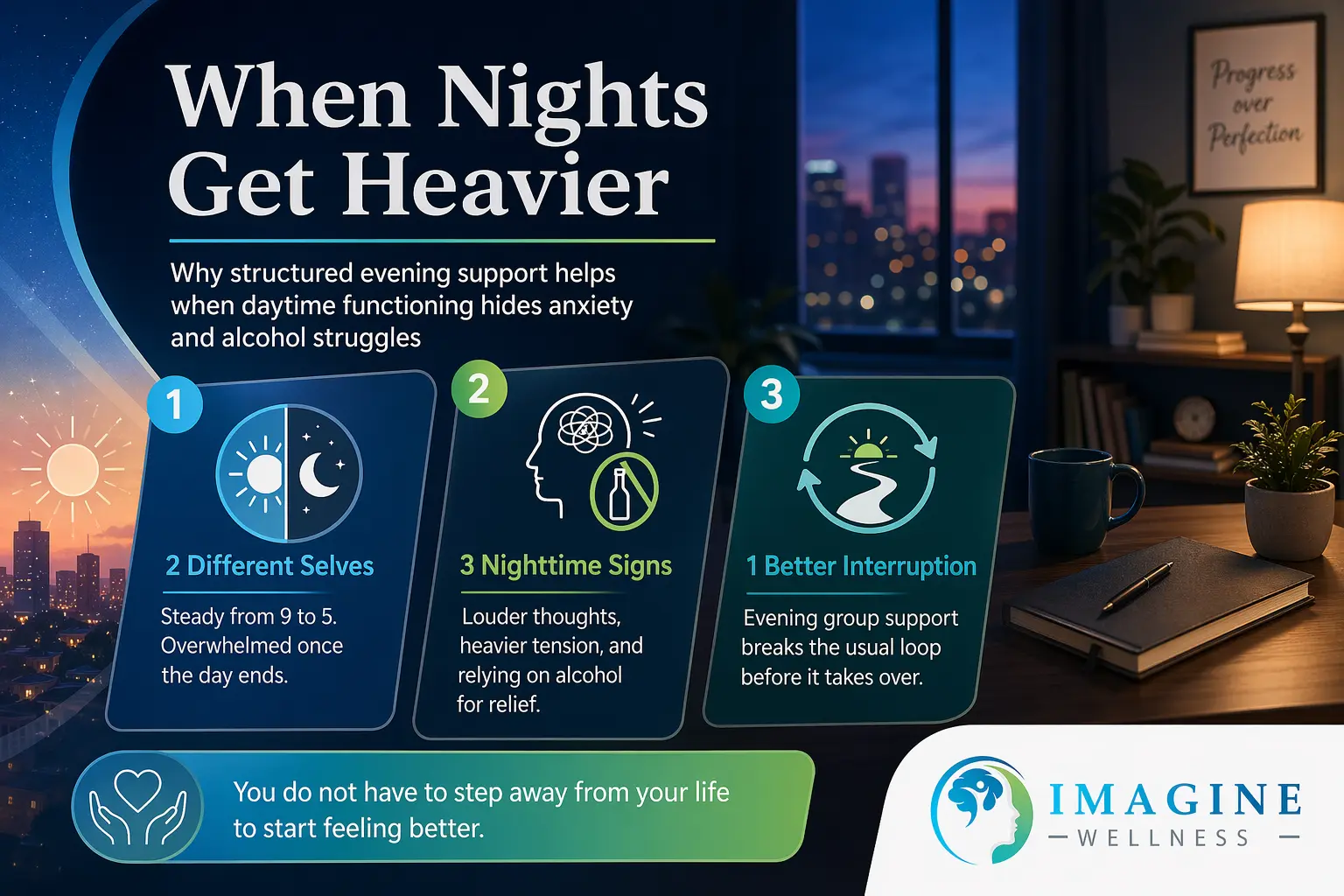
You walk through the door, and it’s like something shifts:
- Your thoughts get louder
- Your body finally feels the tension you’ve been ignoring
- The silence feels heavy instead of peaceful
And that’s where the habit kicks in.
Not because you’re reckless. Not because you’re trying to escape your life.
Because you need relief.
That’s the part most people don’t understand.
The Deal You Quietly Made With Yourself
At some point, you probably made a deal.
“I’ll handle everything during the day… and I’ll let myself have this at night.”
It feels fair. Balanced, even.
You earn it.
But here’s the catch—your brain doesn’t split that cleanly.
The anxiety you suppress all day doesn’t disappear. It stacks.
And when you finally stop moving, it all shows up at once.
That drink, or that pattern, starts as a release valve.
Then it becomes the only way you know how to turn the pressure down.
And eventually… it starts turning the pressure up instead.
You’re Not Falling Apart—But You’re Not Okay
This is the hardest place to explain to anyone.
Because technically, you’re fine.
You’re working.
You’re showing up.
You’re not “losing everything.”
But internally?
You’re stretched.
You feel like you’re managing your life instead of living it.
You’re tired in a way sleep doesn’t fix.
You’re starting to rely on something you didn’t used to need.
And maybe the most uncomfortable part:
You can feel it getting worse… slowly.
Not enough to panic.
Just enough to know something’s off.
The Night I Realized It Wasn’t Just “Stress”
For me, it wasn’t some big dramatic moment.
It was a Tuesday.
Nothing went wrong. No crisis. No meltdown.
But I noticed something I couldn’t unsee—I wasn’t looking forward to going home unless I knew I had something to take the edge off.
That was new.
Not “wanting a drink.”
Needing something between me and my own thoughts.
That’s when it clicked.
This wasn’t just stress anymore. It was a pattern.
Walking Into Evening Group Felt Like Admitting Something
The first time I showed up, I didn’t feel ready.
I felt exposed.
Like I was crossing some invisible line—from “handling it” to “needing help.”
I almost didn’t go in.
I sat in my car longer than I want to admit, running through the same thoughts:
- “I’m not like the people who need this.”
- “What if I don’t belong here?”
- “What if this is overkill?”
But here’s what I didn’t expect:
No one cared about proving how bad things were.
People just talked about what was real.
And for the first time in a long time, I didn’t have to perform being okay.
Why Evening Support Works for People Like You
If you’re high-functioning, your struggle isn’t about structure during the day.
It’s about what happens when the structure disappears.
That’s why evening care hits differently.
It meets you exactly where things tend to fall apart.
Instead of going home to your usual loop, you interrupt it.
You sit in a space where:
- You don’t have to explain your anxiety like it’s irrational
- You don’t have to justify why you’re tired all the time
- You don’t have to pretend you’ve got it handled
It’s not about stepping away from your life.
It’s about finally supporting the part of your life that’s been quietly unraveling.
It’s Not About “Fixing” You
This part matters.
You don’t go into something like this to be fixed.
You go because the way you’ve been coping isn’t sustainable anymore.
And deep down, you know it.
Evening group isn’t about turning you into someone else.
It’s about helping you reconnect with the version of you that isn’t constantly bracing for the next wave of anxiety.
The Hardest Shift: Letting Yourself Be Seen
For people like you, this is usually the real work.
Not the coping skills.
Not the education.
Being seen.
Admitting:
- “I’m more anxious than people think.”
- “I don’t feel as in control as I look.”
- “I don’t actually know how to slow my brain down.”
That’s uncomfortable.
But it’s also where things start to move.
Because once you stop performing… you can actually start changing something.
What Changed Over Time
Not everything changed overnight.
That’s important to say.
But slowly, things started shifting in ways I didn’t expect:
- Nights didn’t feel as heavy
- I had other ways to respond to anxiety besides shutting it down
- The gap between “daytime me” and “nighttime me” started closing
I didn’t feel like two different people anymore.
And honestly, that was the biggest relief.
You Don’t Have to Quit Your Life to Get Help
This is where a lot of people hesitate.
You assume getting help means stepping away from everything.
It doesn’t.
Options like an Intensive Outpatient Program IOP are designed for people exactly in this position—still functioning, still working, still showing up… but not okay underneath it all.
You don’t need to disappear to get support.
You just need to stop pretending you don’t need it.
The Cost of Waiting Is Quiet—but Real
It’s not always dramatic.
You won’t necessarily crash your life.
But you might:
- Stay stuck in the same exhausting cycle for another year
- Keep relying on something that slowly takes more than it gives
- Feel more disconnected from yourself over time
That kind of cost doesn’t show up all at once.
It accumulates.
And eventually, it’s harder to ignore.
FAQs: The Stuff You’re Probably Thinking But Not Saying
Do I really need something like this if I’m still functioning?
Functioning doesn’t always mean okay. A lot of people hold things together externally while struggling internally. Support is about how you feel—not just how you look.
What if I don’t feel “bad enough” to be there?
Most people in these settings don’t feel “bad enough” at first. That middle space—where things aren’t falling apart but aren’t working—is exactly where this kind of help fits.
Will I have to share everything right away?
No. You can go at your own pace. But being honest sooner usually makes the experience more helpful.
What if I’m not ready to stop drinking completely?
That’s okay. The goal isn’t perfection—it’s understanding your patterns and building healthier ways to cope. Change often starts with awareness, not all-or-nothing decisions.
How do I know if evening support is the right step?
If your hardest moments happen at night—and your current coping strategies aren’t working anymore—that’s usually a strong sign.
What if I try it and it doesn’t work?
Then you’ll know more than you do right now. Trying something different gives you information—and sometimes the second approach is the one that clicks.
You Can Keep Managing… Or You Can Actually Feel Better
There’s nothing wrong with you for getting this far on your own.
Seriously.
You’ve carried a lot, and you’ve figured out ways to keep going.
But if you’re tired of just managing—if you want your nights to feel like rest instead of something you have to get through—that’s where something different comes in.
If you’re in Peach Tree, Georgia, and this sounds familiar, you don’t have to keep handling it quietly.
Call 678-736-8983 to learn more about our Intensive Outpatient Program in Georgia.