

There are moments when the hardest part of an experience is not the experience itself.
It’s the waiting.
You spend days worrying about an upcoming meeting, replaying every possible mistake. You lose sleep before a medical appointment, convinced you’ll hear devastating news. You dread a social event so intensely that your stomach hurts, only to discover afterward that everything went better than expected.
If this sounds familiar, you’re not imagining it.
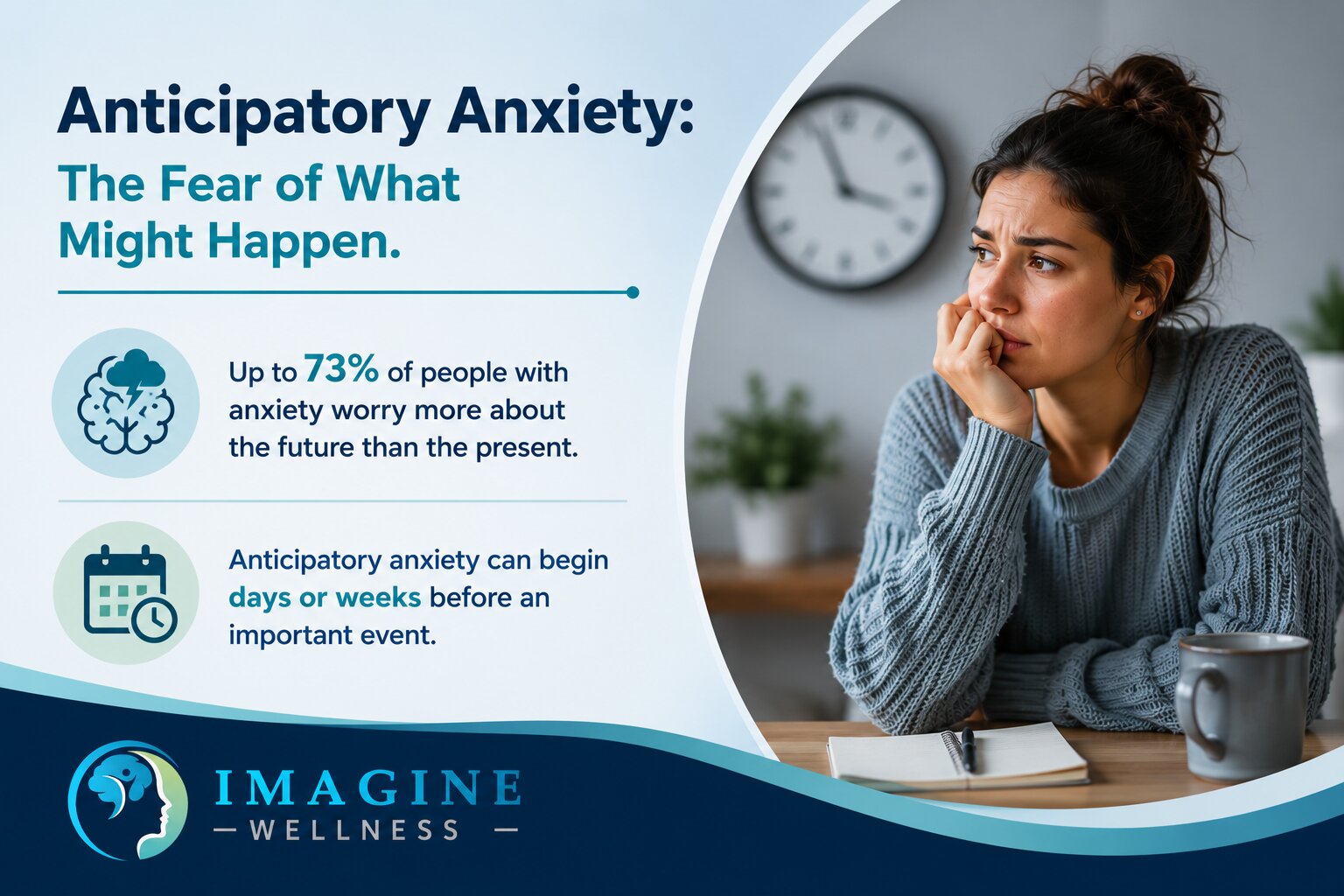
This pattern is known as anticipatory anxiety—a form of anxiety focused on future events rather than what’s happening in the present moment. For many people, the fear of what might happen becomes far more distressing than what actually does happen.
Over time, this constant anticipation can affect work, relationships, physical health, and overall quality of life. Fortunately, it is also something that responds well to evidence-based care. At Imagine Wellness Center, our anxiety treatment programs help people throughout Fayetteville and the south Atlanta metro understand the thoughts and behaviors that keep anxiety going so they can build healthier ways of responding.
Understanding why future-focused anxiety develops is often the first step toward breaking its cycle.
What Is Anticipatory Anxiety?
Anticipatory anxiety refers to intense fear, worry, or distress about something that has not happened yet.
Unlike fear, which responds to an immediate threat, anticipatory anxiety is driven by predictions about the future. The brain begins reacting as though a potential problem is already occurring, even when there is no immediate danger.
Someone experiencing anticipatory anxiety may:
- Worry for days or weeks before an event
- Imagine worst-case scenarios repeatedly
- Feel physically ill before important occasions
- Have difficulty concentrating because of constant worry
- Cancel plans to avoid anticipated discomfort
- Seek repeated reassurance from others
- Spend excessive time preparing “just in case”
While everyone worries occasionally, anticipatory anxiety becomes problematic when future-focused fear begins interfering with daily life or causes significant emotional distress.
Why Anticipation Often Feels Worse Than Reality
One of the most frustrating aspects of anticipatory anxiety is that the event itself frequently turns out to be manageable.
Many people leave a stressful meeting wondering:
“Why was I so afraid?”
The answer lies in how anxiety affects the brain.
When anxiety increases, the brain prioritizes detecting possible threats. Areas involved in emotional processing become highly active, while rational thinking may become less influential. As a result, uncertainty begins feeling dangerous even when objective evidence suggests otherwise.
Instead of asking:
“What’s most likely to happen?”
The anxious mind asks:
“What’s the worst thing that could happen?”
Once that question takes over, the brain starts treating unlikely outcomes as realistic possibilities.
Examples include:
- Assuming one mistake during a presentation will ruin your career
- Believing a delayed text means a relationship is ending
- Expecting every medical symptom to indicate serious illness
- Thinking one awkward conversation will permanently damage a friendship
The longer the brain rehearses these possibilities, the more believable they become.
Ironically, reality rarely unfolds the way anxiety predicts.
The Brain Prefers Certainty
Humans naturally seek predictability.
When something feels uncertain, the brain often attempts to fill in missing information. Anxiety tends to fill those gaps with negative assumptions.
For example:
Instead of thinking:
“I don’t know how tomorrow’s interview will go.”
The anxious brain says:
“I’m probably going to fail.”
Although certainty is impossible, the brain often mistakes pessimistic predictions for preparation.
Unfortunately, imagining failure repeatedly does not improve performance.
It simply increases stress.
Common Triggers for Anticipatory Anxiety
Future-focused anxiety can develop around almost any situation involving uncertainty.
Some of the most common triggers include:
Medical Appointments
Waiting for test results or upcoming procedures often creates significant emotional distress. Many people imagine serious diagnoses long before receiving any information.
Work Responsibilities
Performance reviews, interviews, presentations, deadlines, and difficult conversations frequently trigger prolonged worry.
Social Situations
People may spend days worrying about:
- Parties
- Family gatherings
- Dating
- Networking events
- Public speaking
- Meeting new people
The anticipation often feels much worse than the event itself.
Travel
Airports, flights, unfamiliar places, or changes in routine can become major sources of anticipatory stress.
School
Students commonly experience anticipatory anxiety before:
- Exams
- College applications
- Class presentations
- Clinical rotations
- Graduation
Life Transitions
Major changes naturally involve uncertainty, including:
- Moving
- Marriage
- Divorce
- Pregnancy
- Retirement
- Starting a new job
Even positive changes can activate anxiety because they involve the unknown.
Physical Symptoms Can Begin Long Before the Event
Many people assume anxiety only occurs during stressful situations.
With anticipatory anxiety, symptoms often begin days—or even weeks—in advance.
Physical symptoms may include:
- Rapid heartbeat
- Muscle tension
- Upset stomach
- Nausea
- Sweating
- Restlessness
- Trouble sleeping
- Fatigue
- Headaches
- Difficulty concentrating
- Shortness of breath
Because the body remains activated for extended periods, people often feel exhausted before the anticipated event even arrives.
How Anticipatory Anxiety Fuels Avoidance
Avoidance is one of anxiety’s most powerful reinforcers.
The pattern usually unfolds like this:
Step 1: A Future Event Appears
An invitation arrives.
A meeting gets scheduled.
A doctor calls.
Step 2: Anxiety Increases
The brain immediately predicts possible danger.
“What if I embarrass myself?”
“What if something terrible happens?”
Step 3: Avoidance Feels Like Relief
You cancel.
Reschedule.
Call in sick.
Decline the invitation.
At first, relief feels immediate.
Step 4: The Brain Learns the Wrong Lesson
Instead of learning:
“I could have handled that.”
The brain learns:
“Avoiding kept me safe.”
That belief strengthens anxiety the next time uncertainty appears.
Over months or years, avoidance can shrink a person’s world.
Activities become increasingly limited—not because they are actually dangerous, but because anxiety predicts they might be.
The Hidden Cost of Constant Future Worry
Living with ongoing anticipatory anxiety affects more than isolated situations.
Over time, it may contribute to:
- Reduced confidence
- Chronic stress
- Relationship difficulties
- Missed career opportunities
- Social isolation
- Lower quality of life
- Burnout
- Increased symptoms of depression
Many people eventually realize they are organizing their entire lives around avoiding discomfort rather than pursuing what matters most.
How to Manage Anticipatory Anxiety
The goal is not eliminating uncertainty.
That isn’t possible.
Instead, treatment helps people change how they respond to uncertainty.
Identify Catastrophic Thinking
Start by noticing anxious predictions.
Ask yourself:
- What evidence supports this fear?
- What evidence contradicts it?
- Has this prediction come true before?
- What outcome is actually most likely?
This process helps separate possibilities from probabilities.
Stay in the Present
Anticipatory anxiety constantly pulls attention into the future.
Grounding techniques help return focus to the current moment.
Examples include:
- Slow diaphragmatic breathing
- Naming five things you can see
- Progressive muscle relaxation
- Mindfulness exercises
- Paying attention to physical sensations
Grounding does not erase anxiety but often reduces its intensity.
Reduce Reassurance-Seeking
Repeatedly asking others:
- “Do you think it’ll be okay?”
- “What if this happens?”
- “Are you sure?”
may provide temporary comfort.
Unfortunately, reassurance often reinforces anxiety over time because the brain never learns to tolerate uncertainty independently.
Limit Mental Rehearsing
Many people believe repeatedly imagining difficult situations prepares them.
Often, it simply strengthens anxiety.
When you notice yourself replaying future scenarios over and over, gently redirect your attention toward what you can control today.
Practice Facing Feared Situations
Avoidance teaches anxiety that danger exists.
Gradually approaching feared situations teaches the opposite.
This process, called exposure, is one of the most effective treatments for anxiety when completed thoughtfully and with professional guidance when needed.
Each successful experience provides evidence that anxiety’s predictions are often exaggerated.
How Cognitive Behavioral Therapy Helps Break the Cycle
One reason cognitive behavioral therapy (CBT) is highly effective for anticipatory anxiety is that it addresses both thoughts and behaviors.
Rather than simply encouraging positive thinking, CBT helps people examine how anxiety develops and identify patterns that keep it going.
Treatment often focuses on:
- Identifying automatic anxious thoughts
- Challenging cognitive distortions
- Reducing catastrophic thinking
- Increasing tolerance for uncertainty
- Building healthier coping skills
- Gradually reducing avoidance behaviors
- Practicing behavioral experiments
- Developing confidence through repeated success
Over time, many individuals discover they no longer need certainty before taking action.
Instead, they learn they can tolerate uncertainty without allowing it to control their decisions.
When Professional Help May Be Appropriate
Everyone worries about the future occasionally.
Professional support may be beneficial if anxiety:
- Interferes with work or school
- Prevents participation in daily activities
- Causes frequent panic symptoms
- Leads to ongoing avoidance
- Affects sleep regularly
- Creates significant physical symptoms
- Damages relationships
- Feels difficult to control despite self-help efforts
Seeking treatment does not mean your anxiety is “severe enough.”
It simply means you deserve effective tools before anxiety becomes even more disruptive.
Finding Support in Fayetteville, GA
Living with constant future-focused worry can feel exhausting.
Many people recognize that their fears rarely come true, yet still struggle to stop anticipating the worst. This disconnect is one of the defining characteristics of anticipatory anxiety—and one of the reasons professional treatment can be so helpful. Call Imagine Wellness Center today at (770) 270-3681 to schedule a confidential assessment and take the first step toward healing.
At Imagine Wellness Center, our outpatient mental health programs help individuals throughout Fayetteville and the south Atlanta metro understand how anxiety develops, why avoidance keeps it alive, and how evidence-based therapies such as CBT can help create lasting change. With the right support, it becomes possible to approach uncertainty with greater confidence instead of constant fear.
Frequently Asked Questions
What is anticipatory anxiety?
Anticipatory anxiety is intense fear or worry about future events before they happen. It often involves imagining worst-case scenarios, experiencing physical symptoms of anxiety, and feeling distressed long before the anticipated situation occurs.
How do I stop anticipatory anxiety?
Managing anticipatory anxiety typically involves recognizing catastrophic thinking, practicing grounding techniques, reducing avoidance behaviors, and learning to tolerate uncertainty. Cognitive behavioral therapy (CBT) is one of the most effective evidence-based treatments because it addresses both anxious thoughts and the behaviors that maintain them.
Is anticipatory anxiety an anxiety disorder?
No. Anticipatory anxiety is not a separate mental health diagnosis. Instead, it is a symptom or pattern commonly seen in several anxiety disorders, including generalized anxiety disorder (GAD), social anxiety disorder, panic disorder, health anxiety, and specific phobias.
Why does the anticipation feel worse than the event itself?
Anxiety causes the brain to overestimate danger and underestimate your ability to cope. Before an event, your mind may repeatedly imagine negative outcomes, increasing emotional and physical distress. Once the event begins, your brain often realizes the situation is more manageable than expected.
Can anticipatory anxiety cause physical symptoms?
Yes. Many people experience rapid heartbeat, muscle tension, nausea, sweating, headaches, stomach discomfort, trouble sleeping, fatigue, and difficulty concentrating days or even weeks before the anticipated event.
Does avoiding stressful situations help?
Avoidance usually provides short-term relief but strengthens anxiety over time. Each avoided situation teaches the brain that the feared event was dangerous, making future anxiety more likely. Gradually facing feared situations—often with professional guidance—is generally a more effective long-term strategy.