

If you’ve been caught in a cycle of worry that never seems to shut off, you may have started wondering if something is fundamentally wrong with you.
Maybe your mind jumps to worst-case scenarios before you’ve even finished your morning coffee. Maybe a simple text message goes unanswered and suddenly you’re convinced something terrible has happened. Maybe you replay conversations, analyze every decision, or lie awake at night feeling like your brain refuses to let you rest.
After enough time, many people stop asking, “Why am I so worried?” and start asking, “Am I losing my mind?”
As a clinician, I want you to know something important:
You are not crazy.
In many cases, what you’re experiencing is a brain that has become stuck in a self-reinforcing cycle of fear and hypervigilance. The thoughts may feel overwhelming. The physical symptoms may feel alarming. The exhaustion may feel endless.
But none of that means you’re broken.
Understanding what’s happening beneath the surface can help remove some of the fear and shame that often keep people from seeking help. At Imagine Wellness Centers, we work with individuals facing challenges related to conditions and anxiety, helping them understand what they’re experiencing and learn effective ways to move forward.
Your Brain Is Doing What It Was Designed to Do
One of the biggest misconceptions about chronic worry is that it happens because someone is weak, overly emotional, or unable to cope.
That’s not how the brain works.
Your brain has one primary responsibility above all else: keeping you alive.
To do that, it constantly scans for threats. Most of the time, this system works exactly as intended. If a car swerves into your lane or you hear a loud crash in the middle of the night, your brain quickly shifts into protective mode.
The challenge begins when that alarm system becomes overly sensitive.
Instead of responding only to genuine danger, it starts reacting to uncertainty, discomfort, conflict, embarrassment, future possibilities, or memories of past experiences.
The result is a brain that begins treating ordinary situations as emergencies.
You might logically know you’re safe while simultaneously feeling like something terrible is about to happen.
That disconnect can be incredibly confusing.
How an Anxiety Loop Develops
Think about a smoke detector that becomes so sensitive it goes off every time someone cooks dinner.
Nothing is actually on fire.
The detector simply can’t tell the difference anymore.
A similar process can happen in the brain.
Many factors can contribute to this pattern, including:
- Chronic stress
- Burnout
- Major life transitions
- Trauma
- Relationship difficulties
- Health concerns
- Prolonged uncertainty
- Family history of anxiety
Over time, the brain learns to remain alert even when danger isn’t present.
A typical anxiety loop often looks like this:
- A worrying thought appears.
- Your body responds with physical stress symptoms.
- You notice those symptoms and interpret them as evidence that something is wrong.
- Your fear increases.
- The brain records the experience as proof that the threat was real.
- The cycle repeats.
Each repetition strengthens the pathway.
Eventually, the process becomes so automatic that it feels like it happens without your permission.
That’s why many people describe feeling trapped inside their own minds.
Why Anxiety Can Feel So Physical
One reason people become frightened by anxiety is that the symptoms often feel intensely physical.
You may experience:
Signs You Might Be Stuck in a Fear Cycle
- Racing heart
- Chest tightness
- Shortness of breath
- Dizziness
- Muscle tension
- Digestive discomfort
- Restlessness
- Difficulty concentrating
- Trouble sleeping
- Constant fatigue
Many people assume these symptoms mean something is seriously wrong.
In reality, the body’s stress response is preparing you to deal with a threat.
The problem is that the threat often exists only in anticipation, uncertainty, or fear.
Imagine revving a car engine all day without actually driving anywhere.
Eventually, the engine begins to wear down.
That’s similar to what happens when the nervous system spends months or years in a heightened state of alertness.
Why Positive Thinking Doesn’t Fix It
People struggling with persistent worry often become frustrated because they know their fears don’t make sense.
They tell themselves:
“Stop overthinking.”
“Everything is fine.”
“You’re being irrational.”
Yet the fear remains.
This happens because anxiety isn’t simply a thinking problem.
It’s a nervous system problem.
The emotional centers of the brain process information much faster than the logical centers responsible for reasoning and analysis.
By the time your rational mind tries to step in, your body may already be reacting as though danger is present.
This is why someone can understand that flying is statistically safe and still feel panic boarding an airplane.
Knowledge alone doesn’t always calm an activated nervous system.
Treatment often focuses on helping both the mind and body learn a different response.
The Hidden Ways Anxiety Changes Your Life
Many people assume anxiety only affects their thoughts.
The reality is often much bigger.
Over time, chronic fear can begin shaping daily decisions without you even realizing it.
You might avoid situations that feel uncertain.
You may constantly seek reassurance from friends and family.
You could spend hours researching symptoms online, trying to eliminate every possible risk.
Some people stop pursuing opportunities because they fear failure.
Others become perfectionists because mistakes feel intolerable.
Some withdraw socially because interacting with others feels exhausting.
The common thread is avoidance.
The brain learns that avoiding discomfort creates temporary relief.
Unfortunately, that relief teaches the brain that the situation was dangerous in the first place.
The cycle continues.
What starts as protection slowly becomes limitation.
The Good News: Brains Can Learn New Patterns
If anxiety can be learned, it can also be unlearned.
This is where many people begin to feel hope.
The brain is remarkably adaptable.
Researchers refer to this ability as neuroplasticity, meaning the brain can create new pathways and strengthen healthier patterns over time.
Effective treatment doesn’t usually focus on eliminating every anxious thought.
That’s not realistic.
Instead, treatment helps people change their relationship with those thoughts.
Rather than treating every fearful thought as a warning, people learn how to recognize it as mental activity that doesn’t necessarily require action.
This shift can be powerful.
A thought that once triggered hours of panic may eventually pass through your mind without controlling your day.
That doesn’t happen overnight.
But it happens more often than many people realize.
Seeking Help Doesn’t Mean You’ve Failed
One of the saddest misconceptions I hear from first-time treatment seekers is this:
“I should be able to handle this myself.”
Many people carry that belief for years before reaching out.
They assume asking for help means they aren’t strong enough.
In reality, anxiety often becomes stronger in isolation.
The longer someone struggles alone, the more opportunity the fear cycle has to become ingrained.
Seeking support isn’t a sign of weakness.
It’s a recognition that your brain deserves the same care and attention as any other part of your health.
You wouldn’t expect yourself to recover from a broken bone through willpower alone.
Mental health challenges deserve the same compassion.
The goal isn’t to become fearless.
The goal is to stop living as though every fear deserves control over your life.
FAQ About Anxiety Loops and Recovery
Can anxiety make me feel like I’m losing control?
Yes. Intense anxiety can create powerful physical and emotional sensations that feel overwhelming. Many people worry they’re losing control when they’re actually experiencing a heightened stress response. While the experience can feel frightening, it doesn’t mean you’re “going crazy.”
Why do I keep worrying even when I know everything is okay?
Because anxiety isn’t driven solely by logic. Your brain’s threat detection system can remain activated even when your rational mind understands there’s no immediate danger. This creates a disconnect between what you know and what you feel.
Can anxiety symptoms happen without a clear reason?
Absolutely. Sometimes the brain becomes conditioned to anticipate danger so frequently that symptoms appear automatically. You may notice physical or emotional symptoms before you’re even aware of a triggering thought.
Is overthinking a symptom of anxiety?
Often, yes. Overthinking is frequently an attempt to gain certainty and control. Unfortunately, the more people try to think their way out of uncertainty, the more trapped they can become in the anxiety cycle.
Can treatment really help if I’ve felt this way for years?
Yes. Many people seek help after years of struggling alone. The brain remains capable of learning new patterns throughout life. While progress takes time, meaningful improvement is possible regardless of how long you’ve been experiencing symptoms.
How do I know if it’s time to seek professional help?
If worry, fear, avoidance, sleep disruption, or physical symptoms are interfering with your relationships, work, daily functioning, or overall quality of life, it may be time to speak with a professional. You don’t have to wait until things become unbearable.
You Don’t Have to Keep Fighting Your Mind Alone
If you’re reading this, there’s a good chance you’re tired.
Not just physically tired.
The kind of tired that comes from constantly scanning for danger, questioning yourself, and carrying fear everywhere you go.
Please know that there is nothing weak about reaching out for support.
There is nothing shameful about needing help.
And there is nothing permanent about being stuck in an anxiety loop.
Healing often begins with a simple realization: the problem isn’t that you’re crazy. The problem is that your brain has been working overtime for far too long.
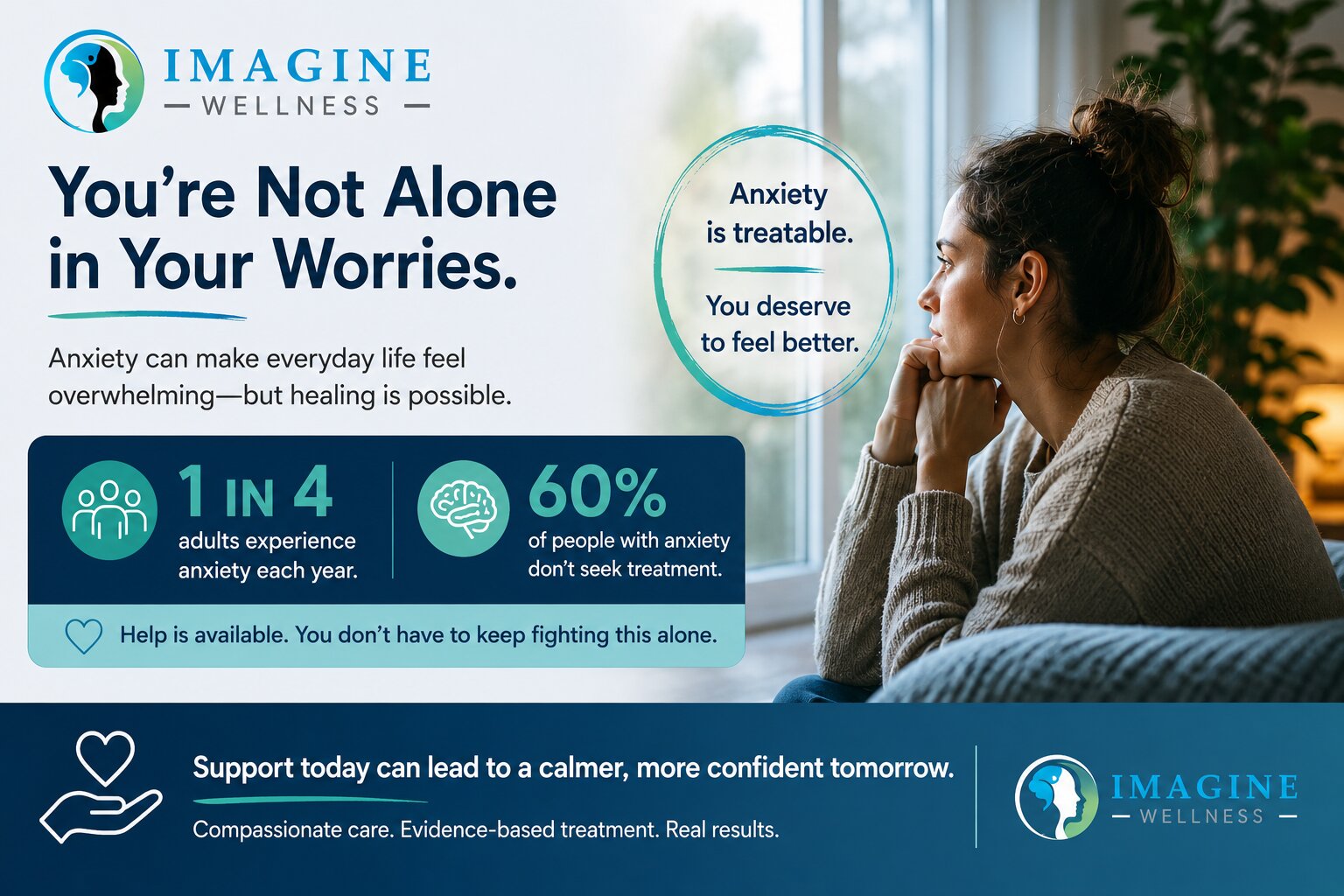
Call 678-736-8983 or visit our conditions and anxiety services to learn more about our conditions, anxiety services in your area.