

Have you ever walked away from a conversation wondering if you shared too much too soon?
Or perhaps you’ve been on the receiving end of an interaction where someone you barely knew suddenly disclosed deeply personal experiences, leaving you unsure how to respond.
In recent years, people have begun using the phrase trauma dumping to describe these situations. While the term has become popular on social media, it is often used loosely or in ways that unintentionally shame people who are struggling.
The reality is much more nuanced.
The desire to talk about painful experiences is not inherently unhealthy. In fact, sharing difficult emotions with trusted people is often an important part of healing. The difference lies in how, when, and with whom those experiences are shared.
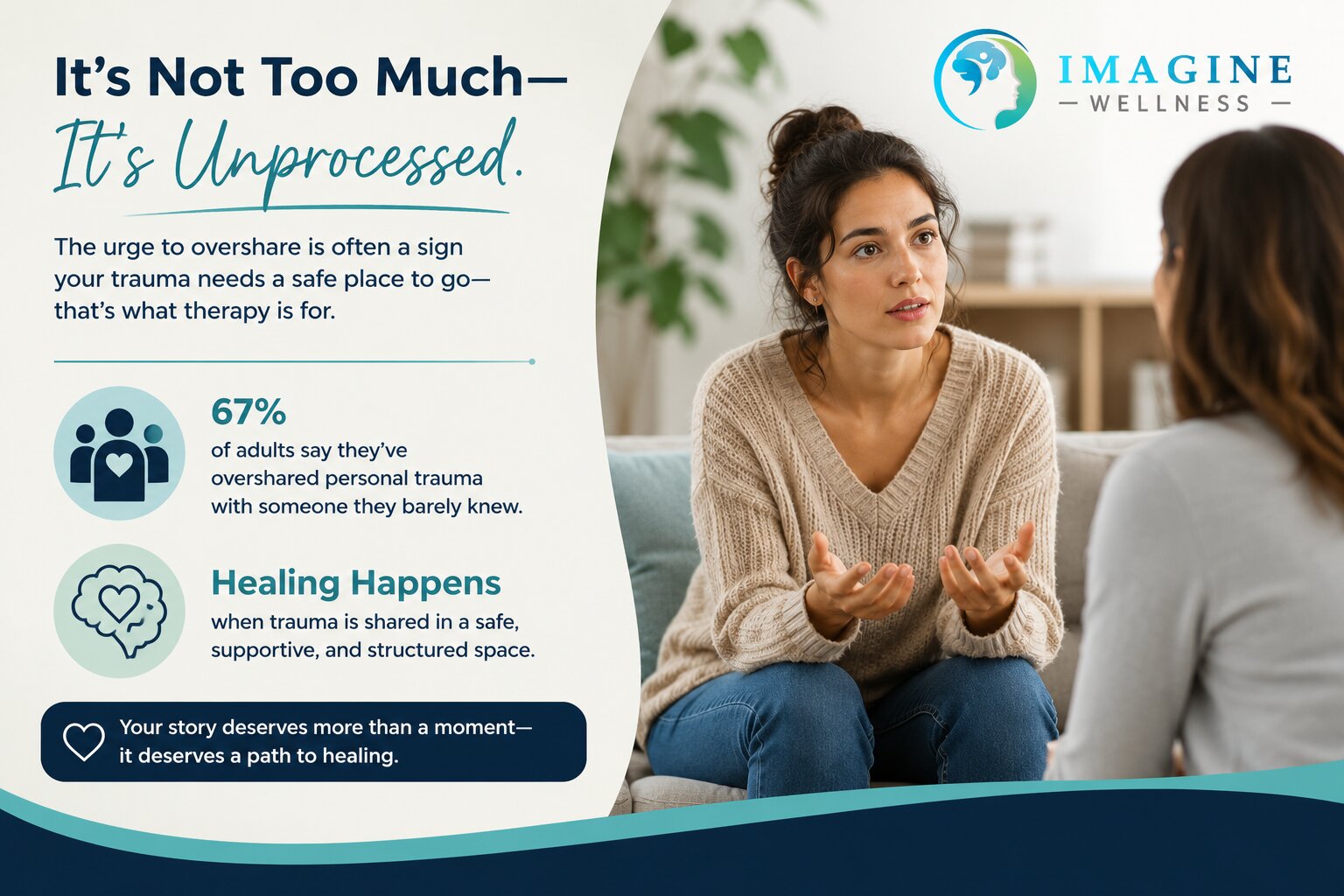
For many individuals, repeated oversharing isn’t a sign of attention-seeking or weakness—it’s a sign that painful experiences haven’t had a safe place to be processed. At Imagine Wellness Center, our trauma treatment programs help individuals throughout Fayetteville and the south Atlanta metro work through traumatic experiences in a supportive, structured environment where healing can happen without fear of judgment.
Understanding the difference between trauma dumping and healthy vulnerability can help strengthen relationships while guiding people toward the support they truly need.
What Is Trauma Dumping?
Trauma dumping refers to sharing intensely personal or traumatic experiences in ways that overwhelm the listener or occur without considering whether the other person is emotionally prepared or willing to receive that information.
Unlike intentional conversations where both people agree to discuss difficult topics, trauma dumping often happens:
- Very early in relationships
- Without asking for consent to have a heavy conversation
- During conversations that unexpectedly become emotionally intense
- Repeatedly with little awareness of the other person’s emotional capacity
Importantly, trauma dumping is not a clinical diagnosis or an official mental health condition.
Instead, it describes a communication pattern that may occur when someone is carrying unresolved emotional pain and has few opportunities to process it safely.
In many cases, the person sharing isn’t trying to overwhelm anyone.
They’re simply looking for relief.
Trauma Dumping vs. Healthy Vulnerability
One of the biggest misconceptions is that talking about trauma is somehow “too much.”
That isn’t true.
Healthy relationships depend on honesty, emotional openness, and vulnerability.
The difference isn’t whether trauma is discussed.
It’s how it’s shared.
Healthy Vulnerability
Healthy emotional sharing often includes:
- Mutual trust
- Appropriate timing
- Respect for boundaries
- Checking whether someone is available to listen
- Conversations that move back and forth naturally
- Openness to support rather than only emotional release
For example:
“I’m having a difficult day. Do you have time to talk about something personal?”
This gives the other person the opportunity to say yes or explain that they aren’t emotionally available at that moment.
Trauma Dumping
By contrast, trauma dumping may involve:
- Sharing deeply distressing experiences without warning
- Assuming someone can immediately provide emotional support
- Repeatedly discussing traumatic events without processing them
- Little awareness of how the conversation affects the listener
- Seeking relief without establishing emotional boundaries
The key difference is not the amount of emotion.
It’s whether the conversation occurs within a mutually supportive and emotionally appropriate context.
Why Trauma Dumping Happens
People rarely overshare because they want to make others uncomfortable.
More often, they do so because they have been carrying emotional pain for a long time without a safe place to process it.
Trauma affects the brain and nervous system in ways that can make difficult memories feel unresolved or emotionally “unfinished.”
Talking about those experiences may provide temporary relief.
If someone lacks supportive relationships or access to therapy, they may begin sharing with:
- Coworkers
- New acquaintances
- Social media audiences
- Casual friends
- Romantic partners very early in relationships
Often, this isn’t a conscious choice.
It’s an attempt to find understanding, connection, or validation.
In many cases, the urge to share reflects an unmet emotional need rather than poor intentions.
The Role of Unprocessed Trauma
Traumatic experiences don’t always remain neatly stored in memory.
They can continue influencing:
- Thoughts
- Emotions
- Relationships
- Physical health
- Stress responses
- Sense of safety
When trauma remains unprocessed, the nervous system may continue searching for ways to reduce emotional pressure.
Talking becomes one of those outlets.
Unfortunately, if those conversations happen without appropriate support, they may bring temporary relief without promoting lasting healing.
How Trauma Dumping Can Affect Relationships
Even when intentions are good, repeated emotional oversharing can place significant strain on relationships.
The listener may begin feeling:
- Emotionally overwhelmed
- Responsible for “fixing” the situation
- Guilty for needing boundaries
- Drained after conversations
- Unsure how to respond
Meanwhile, the person sharing may feel:
- Rejected
- Embarrassed
- Misunderstood
- Ashamed
- Afraid of opening up again
Neither person is necessarily doing something wrong.
Both may simply need healthier ways to communicate about emotional pain.
Recognizing these patterns can create opportunities for more supportive, balanced conversations.
Boundaries Are Healthy for Everyone
One of the most compassionate things people can do—for themselves and others—is practice healthy emotional boundaries.
If you’re sharing something deeply personal, it can help to ask:
- “Is now a good time to talk?”
- “Do you have the emotional space for something heavy?”
- “I’d really appreciate someone listening if you’re available.”
Likewise, if you’re on the receiving end, it’s okay to respond honestly:
- “I care about you, but I’m not in the right headspace right now.”
- “Can we talk later when I can give you my full attention?”
- “I want to support you, but I think this is something a therapist could really help with.”
Boundaries are not rejection.
They protect relationships by ensuring support happens in ways both people can sustain.
Social Media Has Changed Emotional Sharing
Online platforms have made personal storytelling more common than ever before.
For many people, sharing painful experiences online provides:
- Validation
- Community
- Reduced isolation
- Hope
At the same time, social media often lacks important elements of healthy emotional processing.
Followers cannot provide individualized support.
Context is limited.
People reading the content may be emotionally affected without warning.
This doesn’t mean discussing trauma online is always harmful.
Rather, it highlights why deeply painful experiences often benefit from spaces specifically designed for healing.
Where Trauma Actually Belongs
Trauma deserves to be heard.
It deserves compassion.
Most importantly, it deserves a place where healing—not just emotional release—can occur.
Professional therapy provides something everyday conversations cannot always offer:
- Emotional safety
- Clinical guidance
- Evidence-based treatment
- Consistent support
- Healthy boundaries
- Skills for processing traumatic memories
Therapy is not about discouraging people from talking.
It’s about creating an environment where talking leads to meaningful healing rather than temporary relief.
How Therapy Helps Process Trauma
Trauma-focused therapy helps people understand how past experiences continue affecting present emotions, relationships, and daily life.
Treatment may include:
Cognitive Behavioral Therapy (CBT)
CBT helps identify thought patterns shaped by trauma and develop healthier ways of responding.
Trauma-Focused Approaches
Evidence-based trauma therapies help individuals process difficult memories in ways that reduce emotional distress over time.
Emotional Regulation Skills
People learn strategies for managing overwhelming emotions before they become difficult to contain.
Building Healthy Relationships
Therapy also helps individuals:
- Set boundaries
- Improve communication
- Develop trust gradually
- Recognize safe relationships
- Strengthen emotional resilience
The goal isn’t to stop talking about trauma.
It’s to create lasting healing so trauma no longer controls daily life.
When Professional Support May Be Helpful
Consider speaking with a mental health professional if:
- You frequently feel compelled to tell strangers or acquaintances about traumatic experiences.
- You feel emotionally overwhelmed after discussing your past.
- Painful memories interfere with work, relationships, or sleep.
- You notice recurring feelings of shame, guilt, or isolation.
- You find yourself reliving traumatic events or avoiding reminders of them.
- Relationships repeatedly become strained because of unresolved emotional pain.
Seeking help is not a sign that you’ve shared “too much.”
It’s a sign that your experiences deserve the care and support needed to process them safely.
Finding Trauma Support in Fayetteville, GA
Trauma affects everyone differently. Some people become quiet and withdrawn, while others feel a strong need to talk about their experiences in search of understanding and relief. Neither response is a personal failure—they are often signs that the nervous system is trying to cope with overwhelming experiences.
At Imagine Wellness Center, we provide outpatient mental health services for individuals throughout Fayetteville and the south Atlanta metro. Through individualized therapy and evidence-based trauma care, we help people process difficult experiences in a safe, supportive environment so healing can extend beyond simply telling the story and toward building a healthier future. Call Imagine Wellness Center today at (770) 270-3681 to schedule a confidential assessment and take the first step toward healing.
Frequently Asked Questions
What is trauma dumping?
Trauma dumping refers to sharing deeply personal or traumatic experiences in ways that overwhelm the listener or occur without mutual agreement or appropriate emotional boundaries. It is not an official mental health diagnosis but rather a communication pattern often linked to unresolved emotional pain.
Is venting the same as trauma dumping?
No. Healthy venting usually happens within a trusted relationship, with mutual understanding and respect for boundaries. Trauma dumping typically involves sharing intense emotional experiences without considering whether the other person is prepared or able to provide that level of support.
How do I stop trauma dumping?
Start by becoming more aware of when and how you share personal experiences. Asking for consent before discussing heavy topics, building reciprocal conversations, and working with a therapist to process unresolved trauma can help create healthier communication patterns.
Is trauma dumping intentional?
Usually not. Many people who engage in trauma dumping are seeking relief, validation, or connection rather than trying to overwhelm others. The behavior often reflects unmet emotional needs or unresolved trauma rather than harmful intent.
Why is therapy a better place to process trauma?
Therapy provides a confidential, structured, and supportive environment where difficult experiences can be explored safely. Unlike casual conversations, therapy includes evidence-based techniques that help people process trauma, develop coping skills, and reduce the lasting impact of traumatic memories.