
You might be telling yourself it’s just stress. A busy stretch. A rough week.
And maybe part of that is true.
But there’s often a quieter voice underneath that says, this feels different.
If you’ve been googling things like thought spirals, therapy types, or trying to figure out why your mood doesn’t bounce back the way it used to—that’s not random. That’s awareness starting to show up.
If you want to better understand what might be going on beneath the surface, you can explore mental health support options as you read. No pressure—just clarity.
Let’s walk through a simple, honest way to check in with yourself.
Step 1: Notice What Feels Different—Not Just What Feels Wrong
Most people wait for something to feel wrong enough before paying attention.
But early emotional shifts don’t usually announce themselves that way.
They show up as subtle changes:
- You laugh, but it doesn’t land the same
- You rest, but don’t feel recharged
- You go through your day, but feel slightly disconnected from it
Stress usually has a clear cause.
A deadline, a conflict, a packed schedule.
But if that “off” feeling lingers even when things calm down, it’s worth noticing.
Try asking yourself:
- Do I feel like myself lately?
- Am I present, or just getting through things?
Sometimes the earliest signs of depression don’t feel intense.
They feel muted.
Like someone turned the volume down on your life.
Step 2: Pay Attention to Your Energy, Not Just Your Mood
Mood is what we talk about.
Energy is what quietly shapes everything.
You might not feel “sad.”
But everything feels heavier.
Tasks take longer. Decisions feel harder. Even simple things—texts, meals, plans—require more effort than they used to.
This is where many high-functioning people miss the signal.
Because you’re still doing everything.
You’re just more tired doing it.
Check in with yourself:
- Am I more drained than usual, even without a clear reason?
- Do I need more downtime but still don’t feel rested?
Stress can exhaust you temporarily.
But ongoing, unexplained fatigue often points to something deeper.
Step 3: Listen to the Way You Talk to Yourself
This one can be easy to overlook because it happens internally.
But your thought patterns tell a story.
Maybe you’ve noticed:
- You’re harder on yourself than usual
- Small mistakes feel bigger
- Your mind loops on the same worries without resolution
If you’ve been searching for things like CBT vs DBT for negative thought spirals, you’re already trying to make sense of this.
Instead of fighting your thoughts, try observing them:
- Are they more repetitive than usual?
- Do they lean negative, even when nothing specific is wrong?
- Do they feel louder or harder to interrupt?
Stress creates pressure.
But persistent mental loops can signal something more rooted.
Step 4: Check Your Coping Patterns (Gently, Honestly)
Everyone copes. That’s human.
But how you cope—and how often—can shift without you realizing it.
Maybe you’ve noticed:
- Reaching for a drink more regularly
- Staying busy to avoid slowing down
- Scrolling longer than you intended
- Avoiding quiet moments
If you’re sober curious, this step might feel especially familiar.
Not because something is “wrong,” but because you’re starting to ask:
What am I actually trying to manage or escape?
Ask yourself:
- Has this become more of a habit than a choice?
- Does it actually help—or just delay how I feel?
This isn’t about judgment.
It’s about awareness.
Step 5: Notice What You’ve Quietly Let Go Of
This one often slips under the radar.
You don’t always feel worse.
You just slowly stop doing the things that made you feel like yourself.
Maybe:
- You cancel plans more often
- You don’t reach out to people as much
- Hobbies feel like effort instead of enjoyment
It’s subtle. Gradual.
But meaningful.
Try asking:
- What have I been putting off lately?
- Do I still feel connected to things I used to enjoy?
When interest fades, it’s often not about laziness.
It’s about something internal shifting.
Step 6: Ask Yourself the “If Nothing Changes” Question
This is one of the simplest—and most honest—check-ins you can do.
Pause for a moment and ask:
If I keep feeling like this, exactly as it is, how will I feel in a month?
Not catastrophically. Not dramatically. Just realistically.
This question cuts through denial without creating panic.
Because sometimes the issue isn’t how bad things are right now.
It’s whether they’re slowly becoming your new normal.
Step 7: Understand That You Don’t Need Certainty to Take a Step
A lot of people wait until they’re sure something is wrong.
But clarity rarely comes all at once.
It builds.
Through questions. Through noticing. Through small, honest moments like this.
You don’t need to label what you’re feeling.
But if you’ve been recognizing patterns—low energy, mental loops, emotional distance—it may be worth exploring whether underlying conditions, depression could be part of the picture.
Not as a diagnosis.
Just as a possibility to understand.
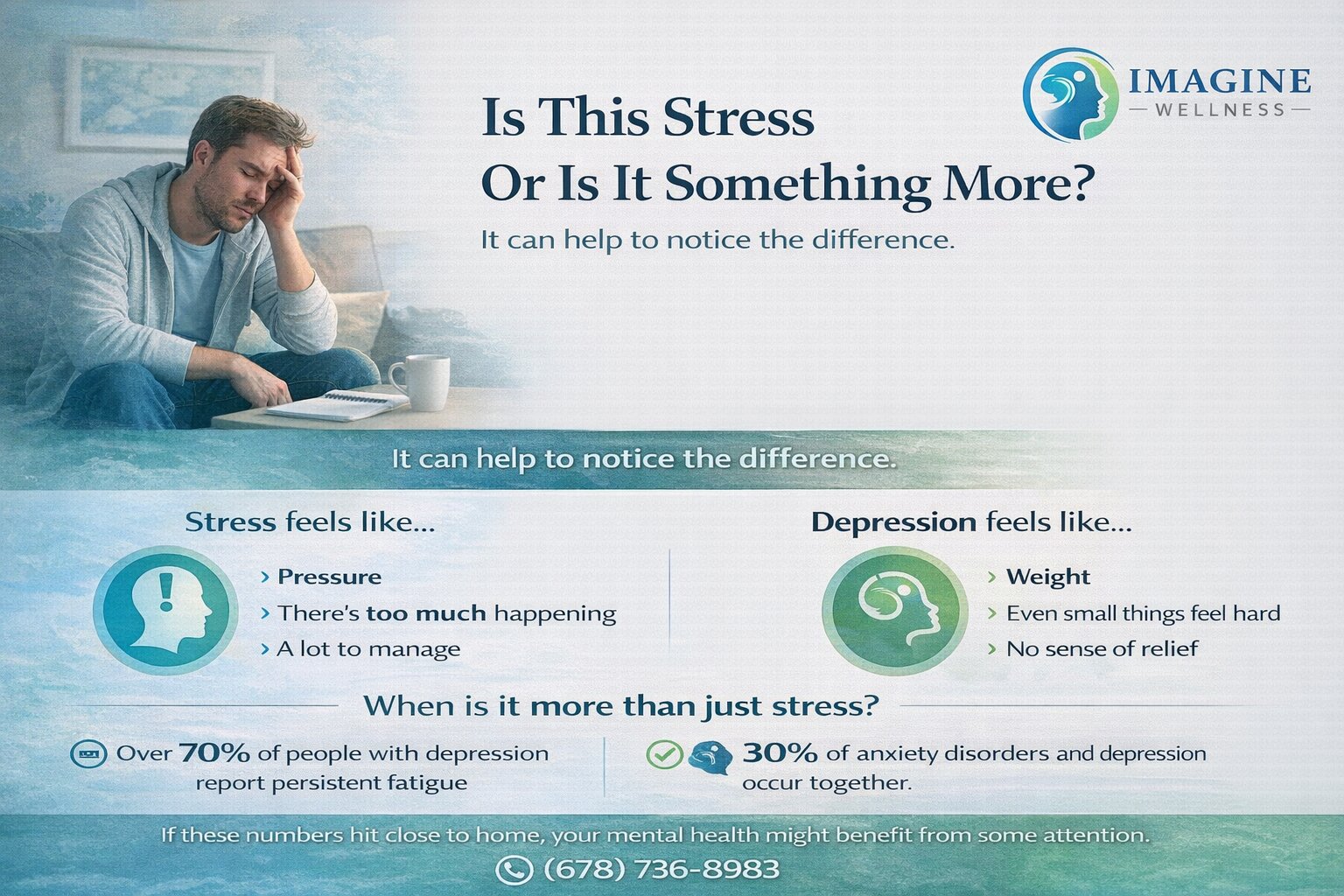
A Simple Way to Tell the Difference
Here’s a way many people describe it:
Stress feels like pressure.
Depression feels like weight.
Pressure says: There’s too much happening.
Weight says: Even small things feel hard.
Sometimes they overlap.
But if the weight doesn’t lift—even when life slows down—that’s something to pay attention to.
You’re Not Overthinking This
If you’ve made it this far, it’s probably not random.
People don’t usually search, reflect, and question like this unless something real is shifting.
And that doesn’t mean something is “wrong” with you.
It means you’re paying attention.
And that’s where change starts.
FAQ: Checking In With Yourself Without Overthinking It
How do I know if this is just stress or something more?
Stress usually improves when the situation changes. If your mood, energy, or thoughts stay low even when things calm down, it may be something deeper worth exploring.
Can I still be functioning and struggling at the same time?
Yes. Many people continue working, socializing, and managing responsibilities while feeling disconnected or emotionally drained underneath.
Do I need a diagnosis to talk to someone?
No. You don’t need certainty or a label to reach out. Talking through what you’re noticing can help you understand it more clearly.
What if I’m just overthinking everything?
That’s a common fear. But consistent patterns—low energy, negative thought loops, loss of interest—are worth paying attention to, even if they seem subtle.
Does being sober curious relate to how I’m feeling?
It can. Sometimes questioning your relationship with substances is connected to a deeper desire to feel clearer, more present, or more like yourself again.
What kind of support is available if I don’t need something extreme?
There are options that don’t require stepping away from your life completely. Support can meet you where you are, whether you need conversation, structure, or guidance.
What’s the first step if I’m unsure?
Start with a conversation. You don’t need to have everything figured out—just a willingness to explore what you’re experiencing.
You’re Allowed to Take This Seriously
You don’t need to wait for things to get worse.
You don’t need to justify how you feel.
If something feels off, that’s enough.
Not for panic.
Just for attention.
If you’re ready to talk through what you’re noticing, call 678-736-8983 or explore your options through treatment in Peach Tree to learn more about our conditions, depression services in Peach Tree, Georgia.