

You’ve probably sat awake at night wondering what changed.
Maybe your child says their chest feels tight. Their heart races for no clear reason. Sleep comes in pieces—if it comes at all. And during the day, something feels… off. Not just stress. Not just worry.
It’s easy—almost automatic—to call it anxiety.
And sometimes, that’s true.
But as clinicians, we also see something else happen quietly: families focus on anxiety because it’s familiar, while other underlying patterns go unnoticed. If you’re already searching for answers, exploring conditions, anxiety support can be a helpful starting point—but it’s not always the full picture.
Let’s slow this down together and look at what might be underneath.
Anxiety Is Real—But It Often Travels With Something Else
Anxiety doesn’t usually show up alone.
It’s more like a signal—your child’s nervous system saying, something isn’t right. That signal can be loud: panic at night, physical discomfort, constant unease.
But the source of that signal isn’t always obvious.
In many cases, anxiety is connected to other emotional or neurological patterns that shape how your child experiences the world. If we only treat the surface—just the anxiety—we can miss what’s driving it.
That’s often why symptoms return.
Not because your child didn’t try. Not because you didn’t do enough. But because the full picture wasn’t visible yet.
What Can Look Like Anxiety—But Isn’t Only That
Some mental health patterns overlap so closely with anxiety that even experienced professionals take time to sort them out.
Here are a few we often consider:
Depression That Feels Restless, Not Quiet
Depression isn’t always low energy or sadness. Sometimes it shows up as irritability, agitation, or that constant “on edge” feeling.
A young adult might say, “I can’t relax,” when underneath, they’re feeling disconnected or overwhelmed in a deeper way.
Trauma That Lives in the Body
If your child has experienced something overwhelming—recently or years ago—the body can stay in a heightened state of alert.
That can look exactly like anxiety:
- Racing heart
- Sudden panic
- Difficulty sleeping
But it’s less about current worry and more about the body trying to protect itself.
Mood Patterns That Shift Quickly
If emotions feel unpredictable—intense one day, flat the next—it may point to mood instability.
This isn’t about being dramatic or “overreacting.” It’s about how the brain regulates emotion, and sometimes that system needs more support than standard anxiety treatment provides.
Sleep Disruption That Fuels Everything Else
Nighttime anxiety can sometimes be rooted in sleep cycle disruption.
When sleep breaks down, everything else becomes harder:
- Emotional regulation
- Stress tolerance
- Physical calm
It becomes a loop—poor sleep increases anxiety, and anxiety disrupts sleep.
Why It Feels Like You’re Back Here Again
This is the part that hurts the most for parents.
You tried. You got help. Maybe things even improved for a while.
And now… you’re seeing the signs again.
It’s easy to turn that inward:
- Did we miss something?
- Should we have done more?
- Why didn’t it stick?
But here’s what we want you to understand clearly:
Progress doesn’t always mean the full story has been uncovered yet.
Sometimes early care focuses on what’s most visible—like anxiety symptoms. Later, as your child grows or stress increases, deeper layers surface.
That’s not failure.
That’s information.
A Familiar Story (That Doesn’t Mean Hopeless)
We’ve worked with families who describe almost the exact same path:
“At first, it was panic attacks at night. We thought it was anxiety. Therapy helped a little, but something kept coming back. It wasn’t until someone looked deeper that we realized there was more going on—and that’s when things started to shift.”
That shift doesn’t come from doing more.
It comes from seeing more clearly.
And clarity creates options.
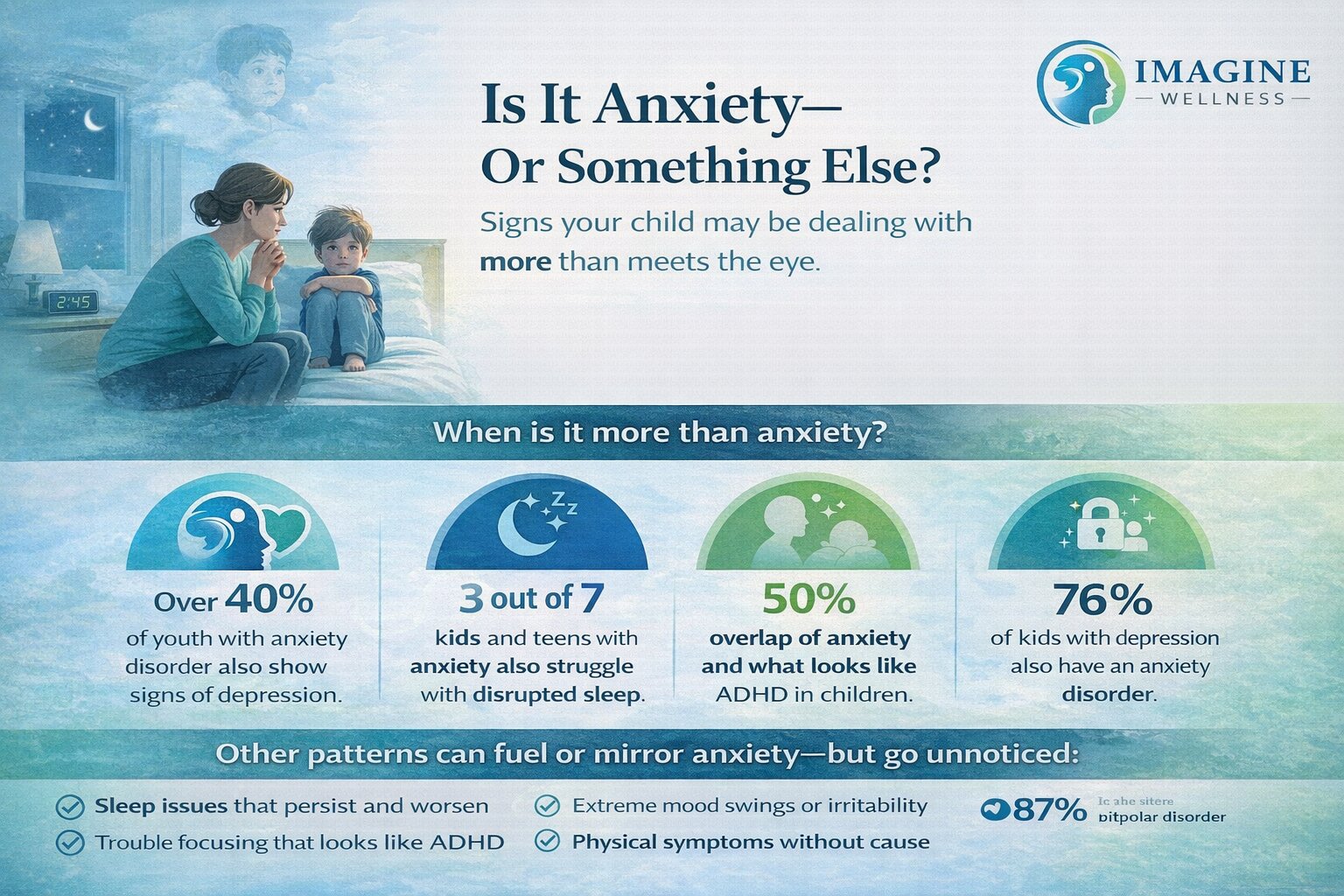
Signs It Might Be Time to Look Beyond Anxiety
You don’t need a formal diagnosis to notice patterns changing.
You might be seeing something more if:
- Symptoms feel inconsistent or unpredictable
- Physical sensations (like chest tightness) happen without clear triggers
- Sleep issues are persistent and worsening
- Emotional responses seem stronger or different than before
- Previous support helped temporarily but didn’t hold
These are not warning signs of something “worse.”
They’re signals that your child’s experience may be more layered than it first appeared.
What a Deeper Look Actually Involves
This isn’t about starting from scratch.
It’s about asking better, more complete questions.
A deeper approach may include:
- A more comprehensive mental health evaluation
- Looking at both emotional patterns and physical health factors
- Adjusting the level of care—sometimes adding more consistent support during the week
- Exploring different therapeutic approaches that match your child’s specific needs
Think of it less like restarting, and more like adjusting the lens.
The goal is clarity—not labels.
Treatment Can Look Different the Second Time Around
If your child has already received help, it’s natural to wonder what could be different now.
Often, it’s not about trying harder—it’s about trying more aligned care.
For some families, that means:
- More structured daytime support instead of once-weekly sessions
- A care team that looks at overlapping emotional patterns, not just one diagnosis
- Support that evolves as your child’s needs change
There is no single path. But there are better-fitting paths once the full picture becomes clearer.
You Are Not the Reason This Is Happening
Parents carry a quiet weight in moments like this.
Even if no one says it out loud, it lingers:
“Did I cause this?”
“Did I miss it?”
Let’s gently set that down.
Mental health is complex. It’s shaped by biology, environment, stress, development, and timing.
Your role isn’t to have all the answers.
Your role is what you’re already doing—paying attention, asking questions, and continuing to show up.
That matters more than perfection ever could.
You’re Not Back at the Beginning—Even If It Feels That Way
This moment can feel like a reset.
But it isn’t.
You have more awareness now. More context. More understanding of what your child experiences day to day.
That changes how you move forward.
And often, this second look—this deeper understanding—is what leads to more lasting progress.
FAQ: What Parents Often Ask in This Moment
How do I know if it’s really more than anxiety?
If symptoms are persistent, changing, or not improving with past support, it’s worth exploring further. You don’t need certainty—just enough concern to ask deeper questions.
Could anxiety still be part of it?
Yes. Anxiety is often one piece of a larger puzzle. The goal isn’t to replace that understanding, but to expand it.
What if my child resists getting help again?
That’s very common, especially if they feel like “nothing worked before.” Sometimes the approach needs to change—not just the message. Gentle, consistent support matters more than pressure.
Does this mean their condition is more serious?
Not necessarily. It means it may be more complex than initially understood. Complexity doesn’t remove hope—it just changes the approach.
What kind of support should we consider next?
That depends on your child’s needs. Some benefit from more structured, multi-day care. Others need different therapeutic approaches. A comprehensive evaluation can help guide that decision.
A Gentle Next Step
If you’re starting to feel like anxiety doesn’t fully explain what your child is going through, it may be time to look a little deeper—with the right support.
You can call 678-736-8983 or visit our page on conditions, anxiety services in Peach Tree, Georgia to learn more about how we help families understand the full picture and find care that truly fits.
You don’t have to solve this alone. And you don’t have to get it perfect—you just have to keep going.