

If you’re the parent of a young adult who has started using substances again, there is a good chance your brain rarely gets a day off.
You wake up and check your phone.
You wonder whether they made it home safely.
You think about the conversation you had yesterday and replay every sentence.
You wonder if you said too much.
Or not enough.
You start imagining what next week could bring.
Then next month.
Then six months from now.
Before breakfast, your mind has already traveled through dozens of possible futures.
At Imagine Wellness Centers, we meet parents carrying this burden every day. Many arrive believing they simply care deeply about their child. And they’re right.
But many also discover that the endless stream of “what-if” thoughts they’ve been experiencing may be connected to larger patterns associated with conditions, anxiety.
Most importantly, they discover they aren’t alone.
And they aren’t broken.
They’re carrying more than most people realize.
When Love and Fear Become Difficult to Separate
One of the hardest things about being a parent is that love naturally creates concern.
You care because your child matters.
You worry because their future matters.
You stay alert because you want to protect them.
The challenge comes when concern quietly transforms into constant mental vigilance.
Many parents don’t notice the shift at first.
The thoughts seem reasonable.
What if they relapse again?
What if they’re hiding something?
What if they stop answering calls?
What if this situation gets worse?
What if I miss an important warning sign?
Because these concerns feel realistic, they often seem necessary.
Over time, however, worry can become less about solving problems and more about mentally preparing for every possible disaster.
That process is exhausting.
Why the Brain Keeps Returning to Worst-Case Scenarios
Parents often tell us:
“I know I’m overthinking, but I can’t stop.”
That statement reveals something important.
Most people experiencing excessive worry are aware it’s happening.
The problem isn’t a lack of insight.
The problem is that anxiety often disguises itself as preparation.
Your brain convinces you that if you think hard enough, long enough, and carefully enough, you’ll eventually discover the solution that keeps everyone safe.
Unfortunately, that’s not how uncertainty works.
Life doesn’t provide guarantees.
And when your child is struggling with substance use, uncertainty can feel especially painful.
The brain dislikes uncertainty.
It wants answers.
It wants control.
When neither is available, it often responds by generating more thoughts.
The result can feel like running on a treadmill that never stops moving.
You’re constantly working.
But never arriving.
The Questions That Follow Parents Everywhere
The thoughts rarely stay confined to one part of the day.
They show up while you’re driving.
At work.
In the grocery store.
During conversations.
While watching television.
Even when you’re trying to sleep.
One parent recently described it this way:
“My body is in one room, but my mind is always somewhere else.”
That experience is incredibly common.
Worry pulls attention away from the present and redirects it toward possible futures.
Instead of experiencing what’s happening now, your brain becomes occupied with what might happen later.
That creates a difficult paradox.
The more you care, the harder it becomes to stay present.
The harder it becomes to stay present, the more exhausted you feel.
Why Parents of Young Adults Often Struggle the Most
When children are young, parents have clear roles.
You create rules.
You make decisions.
You provide protection.
As children become adults, those boundaries change.
The responsibility remains.
The control does not.
That transition can be emotionally complicated.
Your twenty-year-old may be legally responsible for their own choices.
Yet every instinct inside you still wants to protect them.
You find yourself standing in a difficult middle ground.
Close enough to care deeply.
Too far away to control outcomes.
For parents whose young adults are struggling with substance use, mental health concerns, or both, that tension can feel overwhelming.
Every setback increases fear.
Every unanswered text creates uncertainty.
Every difficult conversation generates more questions.
Eventually, the questions become their own source of stress.
The Physical Side of Constant Worry
Many people think anxiety exists only in the mind.
The reality is much different.
The body often feels the impact too.
Parents experiencing persistent worry frequently report:
- Difficulty falling asleep
- Frequent waking during the night
- Muscle tension
- Headaches
- Fatigue
- Restlessness
- Digestive discomfort
- Difficulty concentrating
The body was designed to respond to threats.
But when the brain interprets uncertainty as an ongoing threat, the body can remain in a prolonged state of alertness.
Imagine holding your shoulders tense for twelve hours a day.
Eventually they hurt.
The same thing happens emotionally.
A mind that never gets permission to rest eventually becomes exhausted.
When Worry Stops Feeling Like a Choice
One reason anxiety can feel so frustrating is that people often blame themselves for it.
They think they should be stronger.
More positive.
More rational.
Less emotional.
But persistent worry isn’t usually a choice.
Most parents aren’t waking up each morning and deciding to spend the day imagining worst-case scenarios.
They’re responding to fear.
To uncertainty.
To love.
To responsibility.
The problem is that fear doesn’t always know when to stop.
It continues sounding alarms long after those alarms stop being helpful.
Recognizing this can be incredibly important.
Because self-criticism rarely reduces anxiety.
Compassion often does more than judgment ever could.
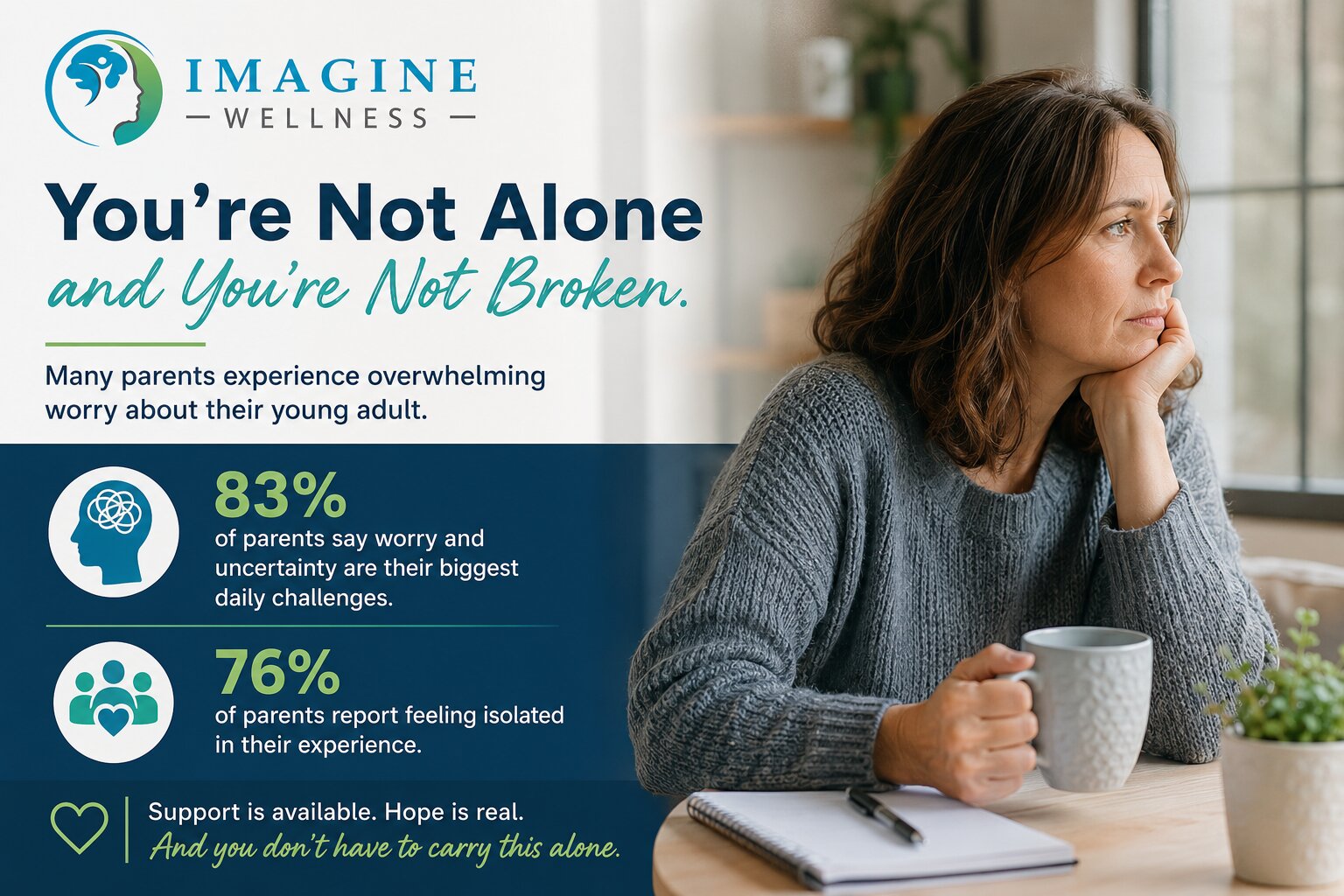
The Difference Between Caring and Carrying Everything
Many parents secretly believe that if they stop worrying, they’re giving up.
As if worry itself is evidence of love.
But love and worry are not the same thing.
You can care deeply without carrying every possible future on your shoulders.
You can support your child without constantly monitoring every outcome.
You can remain engaged without remaining overwhelmed.
This distinction matters.
Because many parents have spent so much time focused on their child’s well-being that they’ve forgotten their own emotional needs.
You deserve support too.
You deserve peace too.
You deserve moments where your thoughts aren’t completely occupied by fear.
Taking care of yourself does not reduce your love for your child.
It helps sustain it.
What Can Help Quiet the Mental Noise?
Many people ask:
“How do I stop the thoughts?”
A more helpful question may be:
“How do I change my relationship with the thoughts?”
Thoughts themselves are not always the problem.
The struggle often comes from believing every thought deserves attention.
Support can help individuals recognize patterns that fuel anxiety.
Many learn practical strategies for managing uncertainty, reducing mental overwhelm, and creating healthier responses to stress.
Others discover that speaking openly about their fears reduces the power those fears hold.
Many families exploring support eventually learn more about available care in Locations and mental health resources designed to help individuals navigate persistent worry and emotional strain.
The goal isn’t perfection.
The goal isn’t eliminating every concern.
The goal is creating enough space for peace to coexist alongside uncertainty.
Hope Doesn’t Require Certainty
One of the most painful things parents tell us is:
“I just want to know everything is going to be okay.”
We understand that desire.
Every parent wants certainty.
But certainty is rarely available.
Hope is.
Hope doesn’t come from knowing exactly what tomorrow holds.
It comes from knowing that support exists regardless of what tomorrow brings.
It comes from learning that worry doesn’t have to control every moment.
It comes from realizing that healing is possible even when life remains uncertain.
You don’t have to eliminate every fear before moving forward.
You only need to believe that your current experience doesn’t have to last forever.
A Final Word for Parents Carrying Too Much
If your mind feels trapped in an endless loop of “what-if” thoughts, please hear this:
You are not the only parent experiencing this.
You are not weak.
You are not failing.
You are responding to a difficult situation with a tremendous amount of love.
But love should not require constant suffering.
The future does not have to be solved today.
The next year does not have to be figured out tonight.
The worst-case scenario does not deserve every ounce of your attention.
There is room for concern.
There is room for hope.
And there is room for you to breathe again.
Frequently Asked Questions
Are constant what-if thoughts normal for parents?
Occasional worry is completely normal. However, when worries become persistent, difficult to control, and begin affecting sleep, mood, or daily functioning, additional support may be beneficial.
Why do I always imagine the worst outcome?
The brain often focuses on potential threats when trying to protect us. During stressful situations, especially involving a child, it may become overly focused on worst-case scenarios.
Can anxiety make it difficult to sleep?
Yes. Many people experiencing anxiety report racing thoughts, difficulty falling asleep, frequent waking, or feeling mentally exhausted even after resting.
Is worrying about my child the same as having anxiety?
Not necessarily. Concern is a normal part of parenting. Anxiety may be present when worry becomes excessive, persistent, and begins interfering with everyday life.
Can parents benefit from mental health support even if their child is the one struggling?
Absolutely. Parents often carry significant emotional stress and can benefit greatly from support, education, and coping strategies.
What if I’ve been worrying like this for years?
Long-standing worry patterns can still improve. Many people learn healthier ways to manage anxiety regardless of how long they’ve experienced it.
Does anxiety ever get better?
Yes. With appropriate support, many people experience meaningful improvement in both the intensity and frequency of anxiety-related thoughts.
Call 678-736-8983 or visit our conditions, anxiety services to learn more about our conditions, anxiety services in Peachtree Corners, GA.