
At first, it works.
A drink takes the edge off.
Scrolling numbs things out.
Staying busy keeps your thoughts from getting too loud.
It doesn’t feel like avoidance. It feels like relief.
And honestly? It is relief — just temporary.
But then something shifts.
You wake up feeling worse.
Your thoughts come back louder.
The thing that used to help… doesn’t quite land the same way anymore.
And you start wondering:
“Why isn’t this working like it used to?”
If you’re asking that, something in you is already paying attention.
That’s often where people begin looking into real support options like anxiety-related conditions care.
Step 1: Look at the Full Cycle — Not Just the Moment of Relief
Self-medication is rarely random.
It’s usually a response to something real:
- Overthinking that won’t shut off
- A constant sense of pressure or dread
- Feeling too much, too fast
So you reach for something that helps you come down.
But the real question isn’t “Does this help right now?”
It’s:
“What happens after?”
Pay attention to the full cycle:
- Do you feel more anxious the next day?
- Does your mood dip after the effect wears off?
- Do you find yourself needing more to get the same relief?
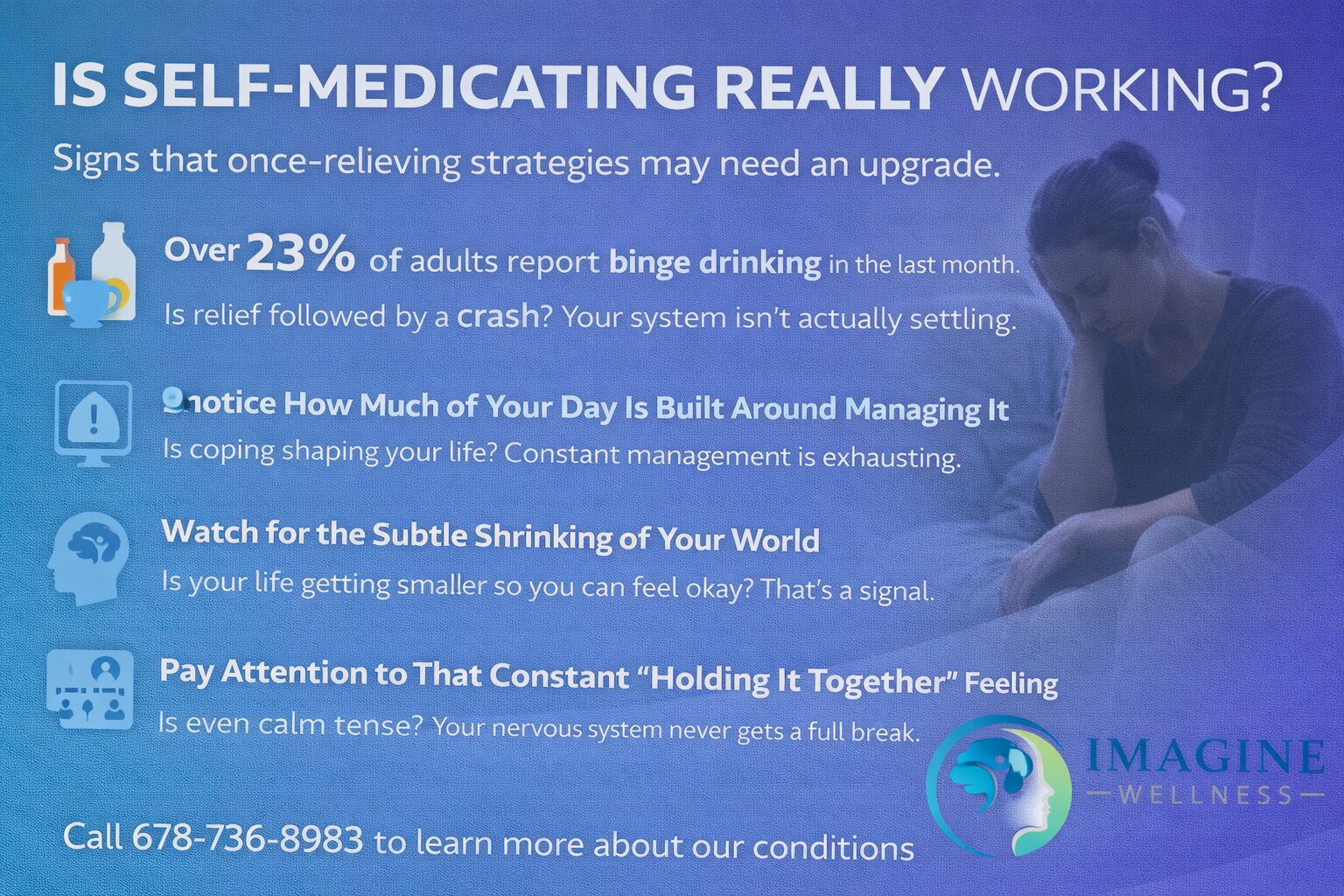
If the relief is followed by a crash, your system isn’t actually settling.
It’s being pulled up… and dropped.
Step 2: Notice How Much of Your Day Is Built Around Managing It
At some point, coping starts shaping your life.
Not in obvious ways — in quiet ones.
You might notice:
- Planning your evenings around when you can “turn off”
- Avoiding certain situations because they feel like too much
- Mentally scanning for exits, distractions, or ways to stay in control
It becomes a background job.
Always running.
Even when nothing is technically wrong.
And that kind of constant management is exhausting in a way that’s hard to explain to other people.
Step 3: Watch for the Subtle Shrinking of Your World
This doesn’t happen overnight.
It happens gradually.
You might:
- Say no to plans you used to enjoy
- Leave early because it feels overwhelming
- Stick to what feels predictable and safe
Again — this makes sense.
Your brain is trying to protect you.
But over time, protection can turn into limitation.
And the question becomes:
“Is my life getting smaller so I can feel okay?”
If the answer is yes, that’s not a failure.
It’s a signal.
Step 4: Pay Attention to That Constant “Holding It Together” Feeling
This one is hard to describe unless you’ve felt it.
It’s like:
- You’re always managing something under the surface
- Relaxation never feels complete
- There’s a quiet tension you can’t fully turn off
Even during calm moments, part of you is still “on.”
Still watching. Still bracing.
That’s not peace.
That’s your nervous system never getting a full break.
And over time, that wears you down — even if everything looks fine on the outside.
Step 5: Get Honest About What You’re Trying Not to Feel
This part can be uncomfortable, but it’s important.
Self-medication isn’t the problem — it’s the strategy.
Underneath it, there’s usually something like:
- Fear that the anxiety will spiral
- Fear of losing control in front of others
- Fear that if you really feel it, it won’t stop
So instead of feeling it, you manage it.
Distract it. Numb it. Push through it.
And again — that makes sense.
But avoidance has a cost.
What you don’t face doesn’t go away.
It waits.
Step 6: Redefine What “Help” Actually Means
A lot of people hesitate here because they picture something extreme.
But support doesn’t have to mean giving up control or changing everything overnight.
It can look like:
- Learning how to calm your body instead of fighting it
- Understanding your patterns without judgment
- Having consistent support so you’re not handling everything alone
Sometimes it includes structured daytime care or multi-day weekly treatment.
Not because things are “bad enough.”
Because you deserve something that actually works.
Step 7: Listen to the Part of You That’s Questioning This
This might be the most important step.
There’s a part of you that already knows something isn’t working.
It’s the part that:
- Notices the patterns
- Feels the exhaustion
- Wonders if there’s another way
And maybe you’ve been pushing that voice aside.
Because change feels big. Unknown. Risky.
But that voice?
It’s not trying to scare you.
It’s trying to move you toward something better.
You Don’t Have to Hit a Breaking Point to Choose Something Different
A lot of people wait for things to get worse.
To feel more justified.
To have a “real reason” to change.
But you don’t need that.
If something isn’t working anymore, that’s enough.
If you’re tired, that’s enough.
If it feels unsustainable, that’s enough.
There are ways to feel better that don’t rely on pushing through or numbing out.
If you’re ready to explore that, you can learn more about available conditions, anxiety services.
You’re Not Weak for Wanting This to Feel Easier
There’s this idea that you should be able to handle it.
Push through it. Manage it. Deal with it.
But constant tension isn’t something you’re supposed to live with.
You’re allowed to want:
- Relief that actually lasts
- Calm that doesn’t disappear the next day
- A mind that feels quieter, not louder
That’s not asking for too much.
That’s asking for something sustainable.
Frequently Asked Questions
How do I know if I’m self-medicating or just coping?
The difference is in what happens over time. If what you’re using helps briefly but leads to more anxiety, more dependence, or more avoidance later — it’s likely self-medication, not sustainable coping.
Do I have to stop everything right away to get help?
No. You don’t have to be perfect or “ready” to start exploring support. Most people begin while still figuring things out. The goal isn’t instant change — it’s understanding what’s actually going on and what might help.
What if my anxiety isn’t that bad?
You don’t need it to be “that bad.” If it’s affecting your daily life, your energy, your choices, or your sense of calm — it matters. Early support often makes things easier, not harder.
What if I’m afraid of losing control if I stop coping this way?
That fear is very real. But the right kind of support doesn’t take control away — it helps you build a different kind of stability. One that doesn’t depend on constant management.
Is it possible to actually feel better without relying on these habits?
Yes. Not overnight, and not perfectly. But many people experience real shifts — less intensity, more calm, more space in their thoughts — when they stop doing this alone and start getting the right kind of help.
You Don’t Have to Keep Managing This Alone
You’ve already done something important by noticing this.
By questioning it.
By not ignoring that quiet voice that says, “This isn’t working anymore.”
You don’t have to figure the rest out by yourself.
Call 678-736-8983 or visit our page to learn more about our conditions, anxiety services in Atlanta, GA.