

You’ve probably gotten very good at pushing through.
Showing up. Responding. Holding it together just enough that no one asks questions.
Even when your chest feels tight, your thoughts won’t slow down, and your body won’t let you rest.
From the outside, it might look like you’re managing.
But inside, it feels like you’re gripping the edge of something all day long — like if you loosen your hold even slightly, everything might spill over.
If you’ve been living like that, it makes sense you’re tired.
And it also makes sense that at some point, pushing through stops feeling like strength — and starts feeling like survival.
That’s often when people begin exploring real support options like anxiety-related conditions care.
Pushing Through Feels Strong — But It’s Actually Draining You
White-knuckling can look like strength.
You keep going. You don’t fall apart. You meet expectations.
But underneath that, something else is happening.
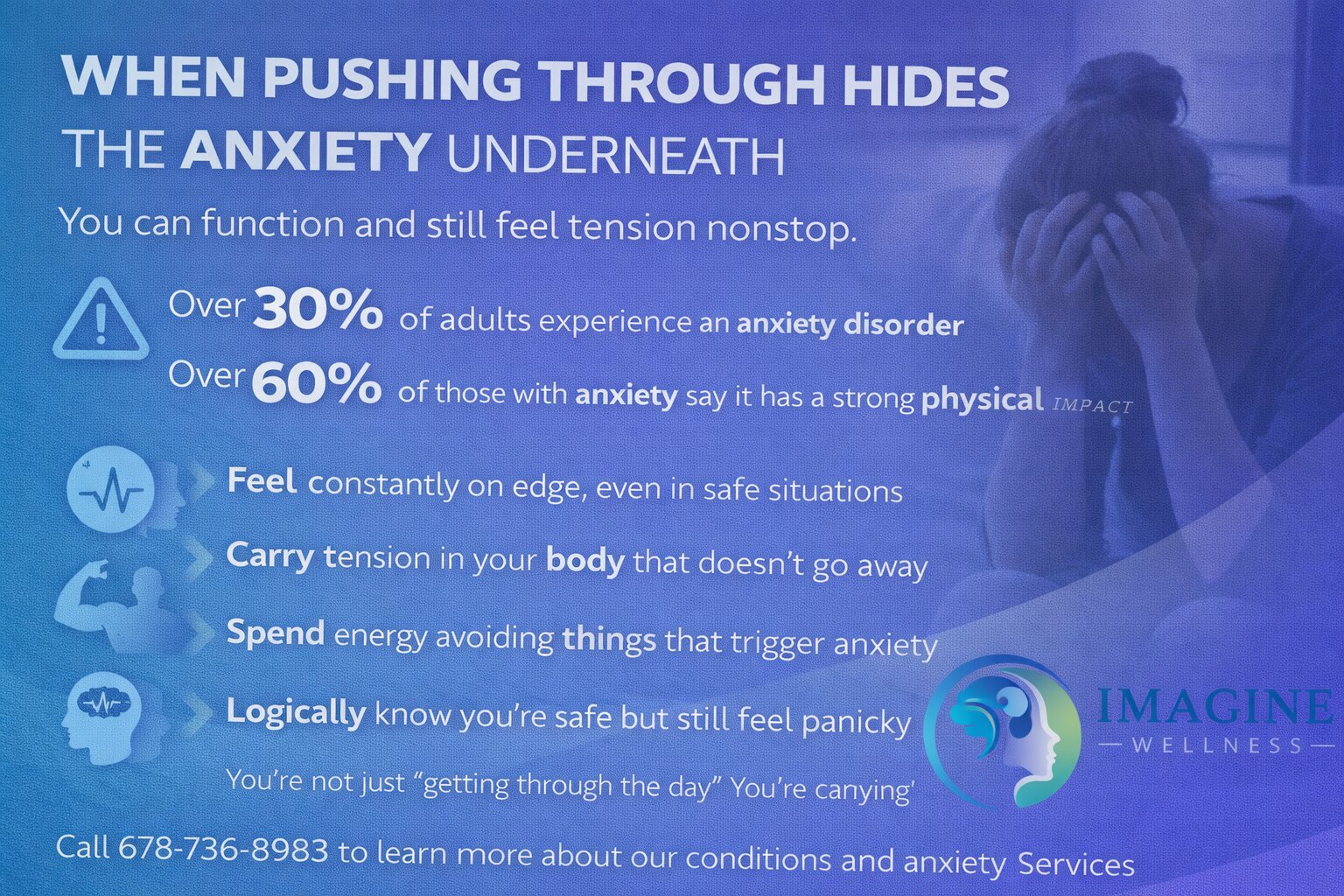
Your body is staying in a constant state of tension:
- Muscles tight, even when you’re resting
- Thoughts looping, even when nothing is wrong
- A background sense that something isn’t okay
You’re not just “getting through the day.”
You’re carrying the day.
And over time, that weight adds up.
You might notice:
- You’re more irritable than you used to be
- Small things feel overwhelming
- Rest doesn’t actually feel restful
That’s not a lack of resilience.
That’s your system getting worn down.
Your Body Is Stuck in Alarm Mode — Even When You’re Safe
One of the most frustrating parts is this:
You can know you’re okay… and still feel like you’re not.
That’s because this isn’t just happening in your thoughts.
It’s happening in your nervous system.
Your body has learned to stay alert — scanning, preparing, bracing.
Even in safe situations, it reacts as if something might go wrong.
So you might experience:
- A racing heart during normal conversations
- A sense of dread without a clear reason
- Difficulty relaxing, even in quiet moments
This isn’t you being dramatic.
It’s your body trying to protect you — just at the wrong intensity, and at the wrong times.
Logic Alone Can’t Turn This Off
If you’ve tried to “talk yourself out of it,” you already know this.
You tell yourself:
- “This isn’t a big deal.”
- “Nothing bad is happening.”
- “I just need to calm down.”
And still — your body doesn’t listen.
That’s not failure. It’s biology.
Your thinking brain and your survival system operate differently.
And when your survival system is activated, logic doesn’t lead.
It follows.
That’s why real relief doesn’t come from thinking harder.
It comes from working with your body, not against it.
The Hidden Patterns That Start to Take Over
White-knuckling isn’t just about how you feel.
It shapes how you live.
Over time, you might start to:
- Avoid situations that feel unpredictable
- Over-plan or overthink to reduce uncertainty
- Rely on control to feel safe
- Pull back from things that once felt easy
These patterns are understandable.
They’re your mind trying to create safety.
But slowly, they can make your world smaller.
And that shrinking can feel just as limiting as the anxiety itself.
Functioning Doesn’t Mean You’re Okay
This is one of the biggest misconceptions.
You can:
- Go to work
- Maintain relationships
- Handle responsibilities
…and still feel completely overwhelmed inside.
Functioning doesn’t equal relief.
It just means you’ve learned how to operate under pressure.
But living that way long-term is exhausting.
You weren’t meant to feel like every day is something you have to push through.
There’s a Difference Between Managing and Actually Feeling Better
A lot of people come into support thinking:
“I just need better coping skills.”
But what they really need is something deeper.
Because coping alone often looks like:
- Getting through the moment
- Containing the feeling
- Returning to baseline exhaustion
Feeling better looks different.
It looks like:
- Your body actually calming down
- Your thoughts slowing without effort
- Moments of ease that don’t feel forced
That shift doesn’t come from trying harder.
It comes from having the right kind of support.
Support Doesn’t Take Away Control — It Gives You Space
It’s completely normal to feel hesitant here.
You might be thinking:
- “What if I lose control?”
- “What if I don’t like how it feels?”
- “What if it changes me?”
Those fears matter.
But real support isn’t about taking something from you.
It’s about giving you something back:
- Space to breathe
- Tools that actually work with your body
- A place where you don’t have to hold everything together
Sometimes that includes structured daytime care or more consistent support during the week.
Not because you’re failing.
Because you’ve been carrying too much, alone.
You Don’t Have to Hit a Breaking Point to Deserve Help
A lot of people wait.
Until they can’t sleep.
Until they can’t focus.
Until something forces the decision.
But here’s the truth:
You don’t have to prove how bad it is to deserve relief.
If it’s affecting your daily life, your energy, your sense of calm — that’s enough.
Getting support earlier doesn’t mean things are worse.
It means you’re choosing to make things easier.
There Is a Way to Feel Different Than This
Not perfect. Not completely free from anxiety forever.
But different.
More grounded.
More steady.
More in control — without forcing it every second of the day.
We’ve seen people move from constant tension to something that feels manageable, even calm at times.
Not because they became stronger.
Because they stopped doing it alone.
If you’re ready to stop white-knuckling your way through every day, you can explore more about available conditions, anxiety services.
Frequently Asked Questions
Why does my anxiety feel physical, not just mental?
Because it is. Anxiety lives in the body as much as the mind. Things like a racing heart, tight chest, or restlessness are part of your nervous system responding — not just your thoughts.
Why can’t I just calm myself down?
You’re not doing anything wrong. When your nervous system is activated, it doesn’t respond well to logic alone. It needs support, repetition, and tools that work with your body — not just your thoughts.
Is it normal to function but still feel overwhelmed?
Yes. Very common. Many people continue working, socializing, and handling responsibilities while feeling constant internal pressure. Functioning doesn’t mean you’re okay — it just means you’ve adapted.
What if I’m scared to start getting help?
That’s completely normal. Most people feel some fear before starting. You don’t have to feel ready forever — just ready enough to take one step.
Will this ever actually feel better?
For many people, yes. Not instantly, and not perfectly. But with the right support, things can feel lighter, more manageable, and less constant. You don’t have to stay in this level of intensity forever.
You’re Allowed to Stop Fighting This Alone
You’ve been strong for a long time.
But strength doesn’t have to look like constant tension.
It can also look like choosing support.
Choosing relief.
Choosing something different.
Call 678-736-8983 or visit our page to learn more about our conditions, anxiety services in Atlanta, GA.