
There’s a moment that doesn’t get talked about enough.
It’s not the day you stopped going.
It’s the days after.
The silence.
The distance.
That quiet thought that keeps coming back: “I probably messed this up.”
Maybe you meant to go back.
Maybe life got loud.
Maybe it just felt like too much.
Whatever the reason — you’re here now.
And that matters more than you think.
A lot of people find their way back through options like flexible outpatient support, especially when they’re not ready for something overwhelming but know they can’t keep doing this alone.
Step 1: Let Go of the Story That You “Failed”
This is the first thing that keeps people stuck.
Not the absence. Not the gap.
The story about it.
“I quit.”
“I couldn’t stick with it.”
“I blew my chance.”
But recovery doesn’t work like that.
There isn’t one window. One shot. One perfect run.
There are attempts. Adjustments. Returns.
Leaving didn’t erase your progress.
It didn’t cancel out what you learned.
It just means something didn’t hold at that moment.
That’s not failure. That’s feedback.
Step 2: Be Honest About What Made You Step Away
Not to blame yourself — but to understand.
Because if you don’t name what didn’t work, you risk repeating it.
Ask yourself, gently:
- Did it feel like too much, too fast?
- Were you overwhelmed outside of treatment?
- Did you feel disconnected or out of place?
- Were you just not ready for the level of change it required?
Most people don’t leave because they don’t care.
They leave because something didn’t feel manageable at the time.
And that distinction matters.
Because now, you can choose something that actually fits your current reality.
Step 3: Choose Support That Fits Your Life — Not the Other Way Around
One of the biggest misconceptions is this:
If you go back, it has to look exactly the same.
Same schedule. Same structure. Same expectations.
But real recovery adapts.
There are ways to re-engage that allow you to:
- Keep your job or responsibilities
- Stay connected multiple times a week without being overwhelmed
- Rebuild consistency without feeling like your entire life is on hold
That middle space — not all-in, not all-alone — is often where people regain their footing.
Step 4: Expect the Return to Feel Uncomfortable (At First)
Let’s be honest about this part.
Coming back can feel awkward.
You might think:
- “What are they going to say?”
- “Do I have to explain everything?”
- “Am I behind now?”
That discomfort is real.
But it’s also temporary.
You don’t need a speech.
You don’t need a perfect explanation.
You can walk back in and simply say, “I’m here.”
That’s enough.
And more often than not, what you’ll find isn’t judgment — it’s relief that you came back.
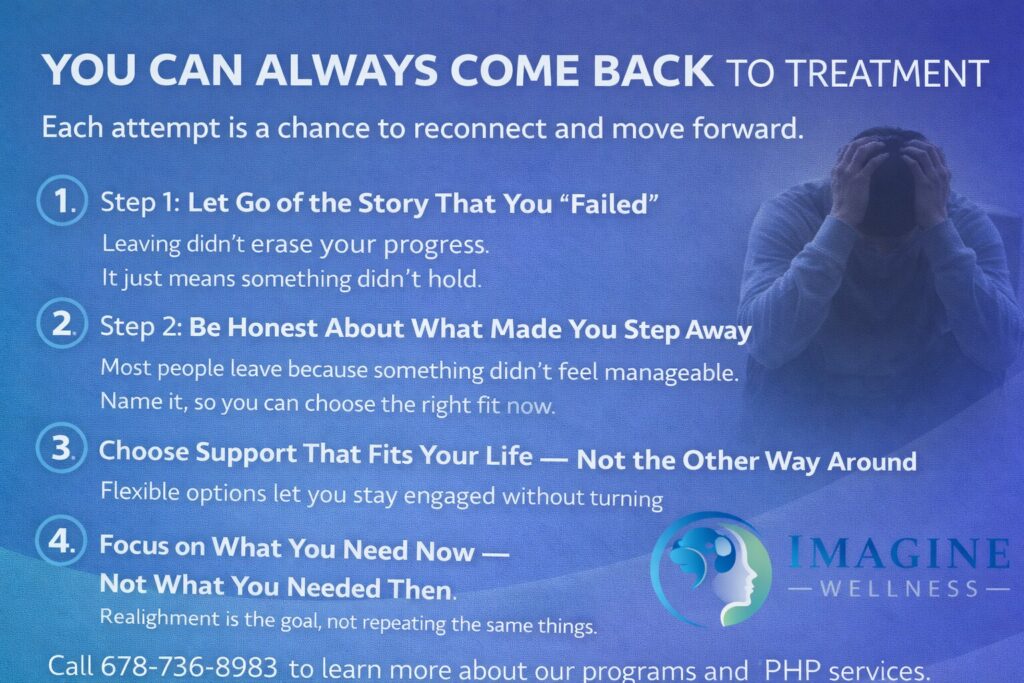
Step 5: Focus on What You Need Now — Not What You Needed Then
This is where things shift.
Because the goal isn’t to rewind.
It’s to realign.
You’re not the same person who first walked in.
Even if things feel messy, you’ve learned something:
- What feels overwhelming
- What doesn’t stick
- What you tend to avoid
- What actually helps, even a little
So instead of trying to recreate the past, ask:
“What would support me today?”
That might look different.
And different isn’t worse. It’s more accurate.
Step 6: Let Support Hold You Before You Feel Ready
This is a big one.
A lot of people think they need to:
- Get stable first
- Get motivated first
- Get “back on track” first
Before they return.
But that’s backwards.
Support is what helps you stabilize.
Support is what helps motivation come back.
You don’t have to arrive ready.
You can arrive uncertain, tired, even discouraged.
That’s actually a very honest place to start.
Step 7: Redefine What “Starting Again” Really Means
It might feel like day one.
But it’s not.
You’re not walking in as someone brand new.
You’re walking in as someone who:
- Has tried before
- Has seen what works and what doesn’t
- Has felt the weight of doing it alone
That’s experience.
And experience changes how you approach things.
So this isn’t starting over.
It’s starting with more awareness.
And that matters.
Step 8: Accept That Progress Isn’t Linear — It’s Layered
There’s a version of recovery people expect:
Clean. Straightforward. Consistent.
But the real version?
It’s layered.
You move forward.
You step back.
You pause.
You return.
And each time you come back, you bring something with you.
Even if it doesn’t feel like it.
Progress isn’t erased by a gap.
It’s built through how you respond to it.
You’re Not Too Far Gone — You’re Just in the Middle of It
That space after stepping away can feel final.
Like you crossed some invisible line.
But you didn’t.
You’re still in it.
Still in the process. Still in the story.
This isn’t the end of anything.
It’s just a part that feels uncertain.
And uncertain doesn’t mean impossible.
If you’re ready to reconnect with support that meets you where you are now, you can explore options like programs, intensive outpatient services.
Frequently Asked Questions
Can I really come back after leaving treatment?
Yes. People step away and return all the time. You’re not disqualified because you left. You’re still welcome — exactly where you are.
What if I feel embarrassed about coming back?
That’s completely normal. But most treatment environments understand that this happens. You’re not the only one who’s taken a break and returned. You don’t need to explain everything perfectly to be accepted again.
Do I have to start from the beginning?
Not necessarily. Your care can adjust based on where you are now. The goal isn’t to restart — it’s to reconnect in a way that fits your current needs.
What if I’m not sure I’m ready yet?
You don’t have to feel 100% ready. Most people don’t. Being willing to explore support again — even a little — is enough to begin.
What if I leave again?
That fear is real. But instead of focusing on “what if I fail again,” try shifting to: “What if I learn something new this time?” Each attempt builds understanding. And understanding makes the next step stronger.
You Don’t Have to Stay Gone Just Because You Left
You’re allowed to come back.
Without explaining everything.
Without being perfect.
Without having it all figured out.
Just… come back.
Call 678-736-8983 or visit our page to learn more about our programs, intensive outpatient services in Atlanta, GA.