

You survived the accident. The hospital visits ended. The bruises faded. Maybe your car was repaired or replaced. Maybe everyone around you quietly moved on.
But your body didn’t.
Now every sudden noise makes you jump. Traffic feels overwhelming. Your chest tightens at red lights for reasons you can’t explain. You feel exhausted after simple errands. Sometimes you don’t even recognize yourself anymore.
That experience is more common than people realize.
At Imagine Wellness Centers’ trauma support services, we meet many people who feel confused by how long the emotional aftermath of an accident can linger. Especially long after the physical danger has passed.
And one of the hardest parts is this: you may look “fine” on the outside while your nervous system still feels like it’s bracing for impact.
Survival Mode Doesn’t Always Shut Off Automatically
A lot of people assume healing happens in a straight line.
The accident happens. You recover. You move on.
But the nervous system doesn’t work like a calendar.
During a frightening or life-threatening experience, the brain and body shift into survival mode. Your heart rate spikes. Your muscles tense. Your senses sharpen. Your body floods itself with stress hormones designed to help you survive.
That response is incredibly intelligent in dangerous moments.
The problem is that sometimes the body struggles to recognize that the danger is over.
So even months later, your nervous system may still react as if something bad is about to happen.
That can look like:
- Flinching at loud sounds
- Feeling anxious in traffic
- Becoming hyperaware of surroundings
- Avoiding certain roads or intersections
- Feeling physically tense all day
- Having trouble sleeping or relaxing
- Feeling emotionally disconnected from other people
For many survivors, this creates a strange internal conflict.
Your logical brain says, “I’m safe.”
Your body says, “Stay alert.”
Living between those two messages is exhausting.
Hypervigilance Can Make Everyday Life Feel Heavy
One of the most misunderstood parts of emotional recovery after an accident is hypervigilance.
Hypervigilance means your nervous system stays on guard even in relatively safe situations.
You may notice yourself constantly scanning for danger without realizing it. Watching every car around you. Sitting near exits in restaurants. Feeling uneasy in crowded places. Reacting intensely to sudden movement or sound.
Sometimes people become frustrated with themselves because the reactions feel irrational.
But trauma responses are rarely logical in the moment.
They are protective.
Your body learned that life can change instantly. It learned that danger can appear without warning. And now it’s trying to prevent that from happening again.
The nervous system doesn’t care whether the threat is statistically likely. It cares whether something feels familiar to the original danger.
That’s why even small things can trigger strong reactions:
- Screeching tires
- Sudden braking
- A slammed door
- Rainy roads
- Emergency sirens
- Fast-moving traffic
For some people, these moments create panic. For others, they create irritability, numbness, or emotional shutdown.
Trauma isn’t always loud.
Sometimes it looks like becoming emotionally tired all the time.
Emotional Numbness Can Be Part of the Aftermath Too
Not everyone experiences obvious fear after an accident.
Some people feel disconnected instead.
They stop feeling excited about things they used to enjoy. Relationships feel harder to engage in. Conversations feel draining. They go through daily routines almost mechanically.
This can feel especially confusing for long-term alumni who expected life to feel more meaningful after doing so much work on themselves.
You may start asking questions like:
- “Why do I still feel off?”
- “Why can’t I relax?”
- “Why do I feel emotionally flat?”
- “Why does everything feel distant?”
A lot of people assume trauma always looks dramatic. Crying. Flashbacks. Panic attacks.
But sometimes the nervous system protects itself by numbing.
It lowers emotional intensity across the board — not just fear, but joy too.
That emotional distance can make people feel guilty or disconnected from their own lives.
Especially when everyone else assumes they should feel grateful just to have survived.
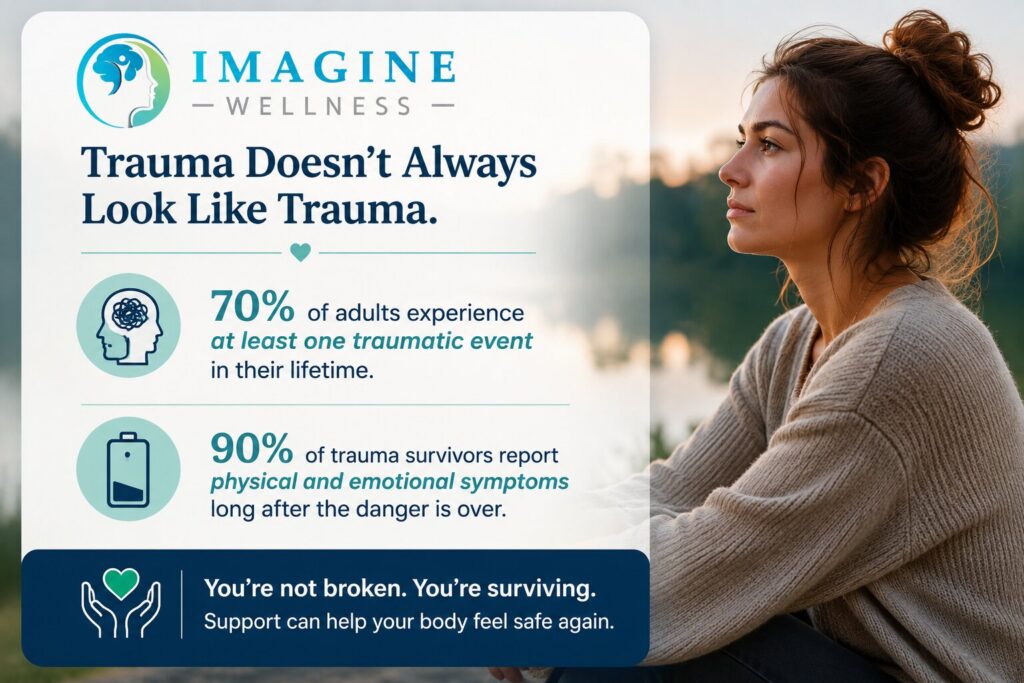
The Pressure to “Be Over It” Can Make Things Worse
There’s often an unspoken timeline after traumatic events.
In the beginning, people check in constantly. Friends ask questions. Family shows concern.
Then gradually, the world moves on.
But your nervous system may still be stuck in the aftermath.
That disconnect can create shame.
You might start minimizing your experience:
- “Other people have been through worse.”
- “I should be fine by now.”
- “It’s been months.”
- “Why can’t I just move on?”
The problem is that shame tends to keep people silent.
And silence often keeps the nervous system trapped in isolation.
Many survivors become incredibly skilled at functioning while struggling internally. They go to work. Take care of their families. Smile during conversations.
Meanwhile, their body stays tense almost every waking hour.
That kind of long-term stress can wear people down emotionally, mentally, and physically.
Sometimes the hardest part isn’t the original event anymore.
It’s the exhaustion of carrying it alone.
Healing Often Happens in Small, Quiet Moments
A lot of people expect recovery to feel dramatic.
But nervous system healing is often subtle at first.
It may look like:
- Driving without gripping the steering wheel
- Sitting through traffic without panic
- Sleeping through the night
- Feeling present during conversations again
- Realizing your shoulders finally relaxed
- Laughing without forcing it
Those moments matter.
Because healing is less about “forgetting” what happened and more about teaching the body that safety is possible again.
That process takes time.
And it rarely happens through pressure or self-criticism.
You cannot shame your nervous system into relaxing.
You cannot force yourself to feel safe through willpower alone.
Safety usually returns through repetition, support, connection, and learning how to reconnect with your body slowly instead of fighting against it.
Trauma Can Change the Way You Relate to the World
One thing many survivors struggle to explain is that trauma changes more than reactions.
It can change identity.
After a serious accident, people sometimes stop trusting themselves, their bodies, or the world around them.
Things that once felt automatic suddenly feel fragile.
You may notice:
- Difficulty making decisions
- Feeling emotionally detached from old routines
- Avoiding situations that once felt normal
- Feeling older or more exhausted than before
- Becoming easily overwhelmed
There’s grief in that.
Not just grief for the accident itself, but grief for the version of yourself that felt carefree or emotionally safe before it happened.
That doesn’t mean healing is impossible.
But it does mean recovery deserves compassion, not impatience.
A nervous system recovering from trauma is not broken.
It’s trying to protect you the best way it knows how.
You Don’t Need to Be Falling Apart to Deserve Support
A lot of people delay getting help because they think their pain isn’t “serious enough.”
Especially if:
- They’re still working
- They’re functioning day to day
- The accident happened a long time ago
- They aren’t having constant panic attacks
But trauma doesn’t always look like crisis.
Sometimes it looks like surviving while quietly carrying tension every day.
You do not need permission to want peace again.
You do not need to prove your suffering before seeking support.
And you don’t have to wait until your symptoms become unbearable before talking to someone about what you’re experiencing.
At Imagine Wellness Centers, we understand that emotional recovery is rarely linear. Our approach to conditions and trauma care focuses on helping people reconnect with safety, stability, and themselves again — without judgment or pressure.
FAQ
Is it normal to still feel anxious months after a car accident?
Yes. Many people continue experiencing nervous system responses long after the physical injuries heal. Anxiety, hypervigilance, sleep issues, and emotional exhaustion can all linger after traumatic experiences.
Why do loud noises still make me jump after the accident?
Your nervous system may still associate sudden sounds with danger. Even if your conscious mind knows you’re safe, the body can continue reacting automatically after trauma.
Can trauma show up as emotional numbness instead of panic?
Absolutely. Some people become emotionally overwhelmed after trauma, while others feel disconnected or emotionally flat. Both can be survival responses.
Why do I feel exhausted all the time after surviving an accident?
Living in a prolonged state of alertness takes a tremendous amount of energy. Constant tension, poor sleep, hypervigilance, and emotional stress can leave people physically and mentally drained.
Will these feelings eventually go away on their own?
For some people, symptoms improve gradually over time. For others, the nervous system remains stuck in survival mode without support. Seeking help can make healing feel less isolating and more manageable.
How do I know if I should talk to someone about trauma?
If your symptoms are affecting your sleep, relationships, emotions, daily routines, or sense of safety, it may help to speak with a professional. You don’t need to be in crisis to deserve support.
Can trauma affect people even if they “handled” the accident well?
Yes. Many high-functioning people appear calm during and after traumatic events but still experience lingering nervous system effects later on.
What does healing from trauma actually look like?
Healing often happens gradually. Many people notice small changes first — less tension, better sleep, fewer panic reactions, improved emotional connection, or feeling safer in situations that once felt overwhelming.
You deserve support even if your pain feels invisible to everyone else.
If you’d like to learn more about how we support people navigating lasting emotional effects connected to conditions and trauma care, our team at Imagine Wellness Centers is here to help.
Call 678-736-8983 or visit our conditions, trauma services to learn more about our conditions, trauma services in Atlanta, GA.