

The nights are usually the hardest.
During the day, you might be able to distract yourself. Stay busy. Keep moving. Maybe you even convince yourself you’re doing okay for a few hours.
Then evening comes.
The house gets quiet. Your thoughts get louder. Cravings creep in slowly or hit all at once. And somewhere underneath the anxiety, shame, or restlessness, there’s often one terrifying thought:
“What if I can’t actually do this?”
If you left treatment early, stopped answering calls from your therapist, or disappeared from recovery support altogether, there may also be another feeling sitting underneath everything else:
“I probably ruined my chance already.”
You didn’t.
A lot of people struggle after detox. A lot of people ghost treatment when things start feeling emotionally overwhelming. And a lot of people need more support than they expected once real life starts again.
That does not mean recovery failed.
It means recovery is happening in real life now — not inside a protected environment.
For people trying to rebuild stability while living at home, exploring ongoing recovery support while living at home can help create structure during one of the most emotionally vulnerable stages of early sobriety.
Detox Gets You Stable — But Recovery Happens After
This is something many people are never fully prepared for.
Detox helps your body clear substances safely. It can reduce immediate physical danger and help stabilize withdrawal symptoms.
But emotional recovery usually begins after detox ends.
That’s often when people start feeling:
- Restless
- Emotionally raw
- Irritable
- Lonely
- Anxious
- Mentally exhausted
- Overwhelmed by cravings
And honestly, many people feel shocked by how intense early sobriety can become emotionally.
Substances often function like emotional anesthesia. They numb stress, fear, grief, trauma, insecurity, loneliness, and overwhelm. Once those substances are removed, emotions tend to return all at once.
It can feel like your nervous system suddenly lost its armor.
That doesn’t mean sobriety is impossible.
It means healing is uncomfortable sometimes.
Home Can Be the Hardest Place to Recover
A lot of people imagine returning home after detox will automatically feel comforting.
Sometimes it does.
But sometimes home is where the stress lives too.
You may walk back into:
- Relationship conflict
- Isolation
- Financial pressure
- Unstructured downtime
- Easy access to substances
- Old routines connected to using
- Emotional triggers that haven’t changed
Even ordinary things can become loaded with cravings.
A certain chair. A certain time of night. Driving past a liquor store. Sitting alone after work. Hearing an argument. Feeling rejected. Feeling bored.
The brain remembers patterns deeply.
That’s why early recovery often feels hardest during quiet moments. Your body may still expect substances to appear whenever stress, loneliness, or discomfort show up.
And when cravings hit hard, people often start panicking:
“Why am I still thinking about this?”
Because healing takes time.
Not because you’re weak.
Cravings Do Not Mean You Secretly Want to Fail
This part matters.
A lot of people feel ashamed of cravings after treatment.
They think:
- “If recovery was working, I wouldn’t still want this.”
- “Maybe I’m not serious enough.”
- “Other people seem stronger than me.”
But cravings are not proof that you don’t care about recovery.
They are often part of the brain recalibrating after long-term substance use and emotional survival patterns.
Your nervous system learned to associate substances with relief. Relief from stress. Relief from fear. Relief from emotional pain. Relief from silence.
The brain does not unlearn that overnight.
Especially during vulnerable times like:
- Nighttime
- Isolation
- Emotional conflict
- Fatigue
- Boredom
- Shame spirals
That’s why support matters so much during early recovery. Because cravings grow louder in secrecy and isolation.
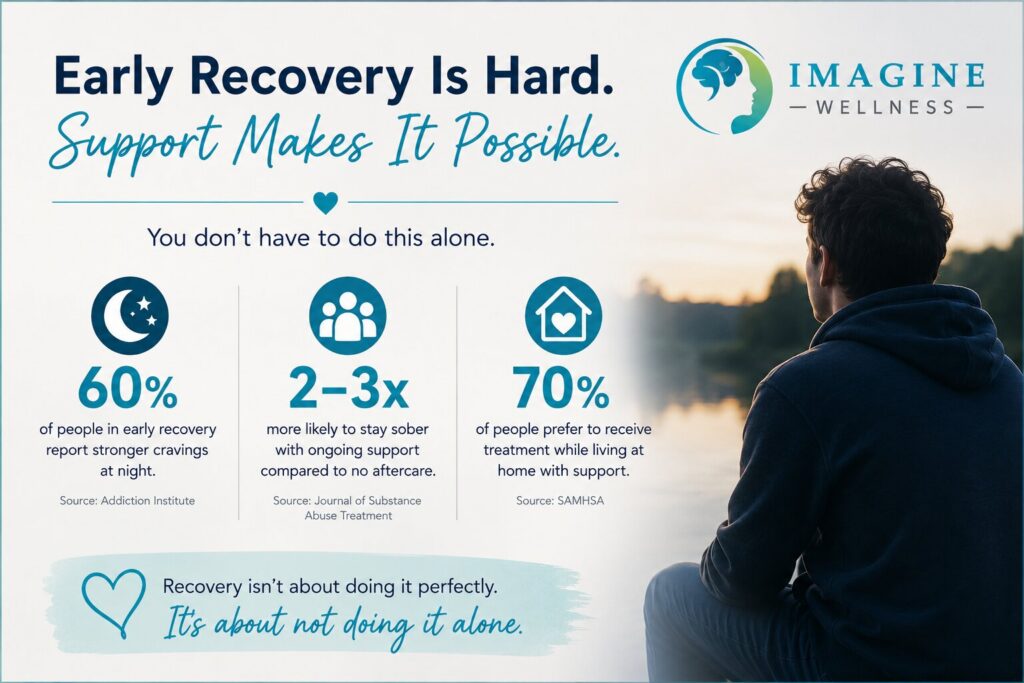
One of the Biggest Risks After Detox Is Isolation
People often leave treatment thinking:
“I just need to stay strong.”
But recovery usually requires more than strength.
It requires connection.
Isolation creates space for relapse thoughts to grow unchecked. When you’re alone with cravings long enough, your brain starts negotiating:
- “Maybe one time wouldn’t matter.”
- “I’ve already messed up anyway.”
- “Nobody would even know.”
- “I can start over tomorrow.”
This is where structure and accountability can interrupt the spiral.
Not through punishment.
Through support.
Sometimes one conversation changes the direction of an entire night.
One meeting. One group session. One person answering the phone when you feel close to giving up.
That’s why staying connected matters, especially when part of you wants to disappear.
Motivation Is Unreliable — Structure Matters More
Many people entering early recovery rely heavily on motivation in the beginning.
But motivation changes constantly.
Some mornings you may feel hopeful. By evening you may feel emotionally wrecked.
That’s normal.
Structure helps carry recovery during moments when motivation disappears.
That might mean:
- Scheduled therapy appointments
- Recovery meetings
- Consistent sleep routines
- Filling evening hours intentionally
- Accountability check-ins
- Building healthier coping habits slowly
Think about recovery like physical rehabilitation after a serious injury.
You would not expect someone to heal a broken leg by simply “trying harder.” They would need repetition, support, guidance, and time.
Sobriety works similarly.
Especially after detox, the brain and body are still healing while daily life stress keeps happening in real time.
Ghosting Treatment Happens More Than People Admit
A lot of clients disappear from treatment because shame convinces them they no longer belong there.
Maybe you relapsed. Missed appointments. Stopped responding to calls. Felt emotionally overwhelmed. Got scared people were disappointed in you.
So you disappeared.
That experience is far more common than people realize.
Many individuals who eventually build stable recovery have chapters where they:
- Left treatment early
- Stopped attending groups
- Relapsed
- Ghosted providers
- Avoided asking for help
Shame tends to isolate people exactly when they need support the most.
But compassionate treatment providers understand something important:
Recovery is rarely linear.
People struggle. Restart. Learn. Return. Try again.
The door is often still open even when shame tells you it isn’t.
Support Does Not Have to Mean Starting Over Completely
One reason people avoid re-engaging with care is because they imagine it has to be all-or-nothing.
They think:
“If I reach out again, they’ll send me away for months.”
But support can look different depending on what someone needs.
For some people, multi-day weekly treatment provides enough structure to help manage cravings, emotional instability, and relapse risk while still allowing them to continue living at home.
That middle level of support can help people rebuild routines gradually instead of trying to hold everything together alone.
Especially during the vulnerable stage right after detox, ongoing care can help people:
- Learn coping tools
- Process emotional triggers
- Rebuild accountability
- Stay connected to support
- Reduce isolation
- Navigate cravings more safely
And importantly, it reminds people they do not have to earn support by being perfect first.
You Are Allowed to Need More Help Than You Expected
A lot of people feel embarrassed when recovery turns out to be harder than they thought.
But early sobriety asks people to face stress, emotions, habits, trauma, loneliness, and daily life without the coping mechanism they relied on before.
That’s a massive adjustment.
Needing support during that process is not failure.
Sometimes healing starts with something very small:
- Answering a call
- Walking back into group
- Being honest about cravings
- Admitting you’re struggling
That honesty can feel terrifying.
But it can also be the moment recovery becomes real instead of performative.
Because pretending you’re okay while silently drowning is exhausting.
And you deserve support before things completely fall apart.
FAQ: Staying Sober While Living at Home
Can you really stay sober while living at home?
Yes, many people do. But recovery at home often requires structure, accountability, and support because daily stressors and triggers remain part of everyday life.
Why are cravings stronger at night?
Nighttime usually brings less distraction, more emotional exhaustion, isolation, boredom, and mental space for cravings to grow louder. Many people associate evenings with previous substance use patterns.
Is it normal to feel emotionally unstable after detox?
Absolutely. Once substances are removed, emotions often return intensely. Anxiety, irritability, sadness, anger, loneliness, and emotional overwhelm are common in early recovery.
What if I left treatment early?
You are not alone. Many people leave treatment before feeling stable. Returning for support later does not erase progress — it’s part of continuing the recovery process.
Does ghosting treatment mean I failed recovery?
No. Many people disconnect from support when shame, relapse, fear, or emotional overwhelm take over. Reaching back out is far more common than people realize.
How do I know if I need more support?
If cravings, isolation, relapse thoughts, emotional instability, or daily functioning are becoming difficult to manage alone, additional support may help create more safety and structure.
Can I get help without living at a facility full-time?
Yes. Some people benefit from multi-day weekly treatment while continuing to live at home. This allows individuals to receive ongoing therapeutic support while gradually rebuilding daily life routines.
Why does recovery feel harder after treatment ends?
Treatment environments provide structure, accountability, and support. Returning home means facing real-life stress, triggers, relationships, and routines again while still emotionally vulnerable.
If early recovery feels harder than you expected, you are not failing — and you do not have to disappear just because things got difficult. Imagine Wellness Centers offers compassionate support for people rebuilding recovery while continuing life at home.
Call 678-736-8983 or visit our ongoing recovery support while living at home to learn more about our programs, intensive outpatient services in Atlanta.