

You don’t look like someone who needs help. That’s the point.
By the time people reach out to us, they’re still showing up—but barely holding it together underneath.
They’re answering emails. Sitting in meetings. Making dinner. Laughing at the right moments.
But there’s a quiet tension running through everything.
And in those first conversations, certain things get said—not dramatically, not as a confession, just… honestly.
Early on, many clients ask questions that sound practical on the surface: Does insurance like Blue Cross cover something that meets several days a week? Can I actually do this without stepping away from everything?
Those questions matter. Not just financially—but emotionally. They’re about whether help is realistic, whether it fits into a life that hasn’t completely fallen apart.
If you’ve found yourself wondering the same thing, you’re not alone—and you can start understanding how structured care works through our multi-day weekly treatment options.
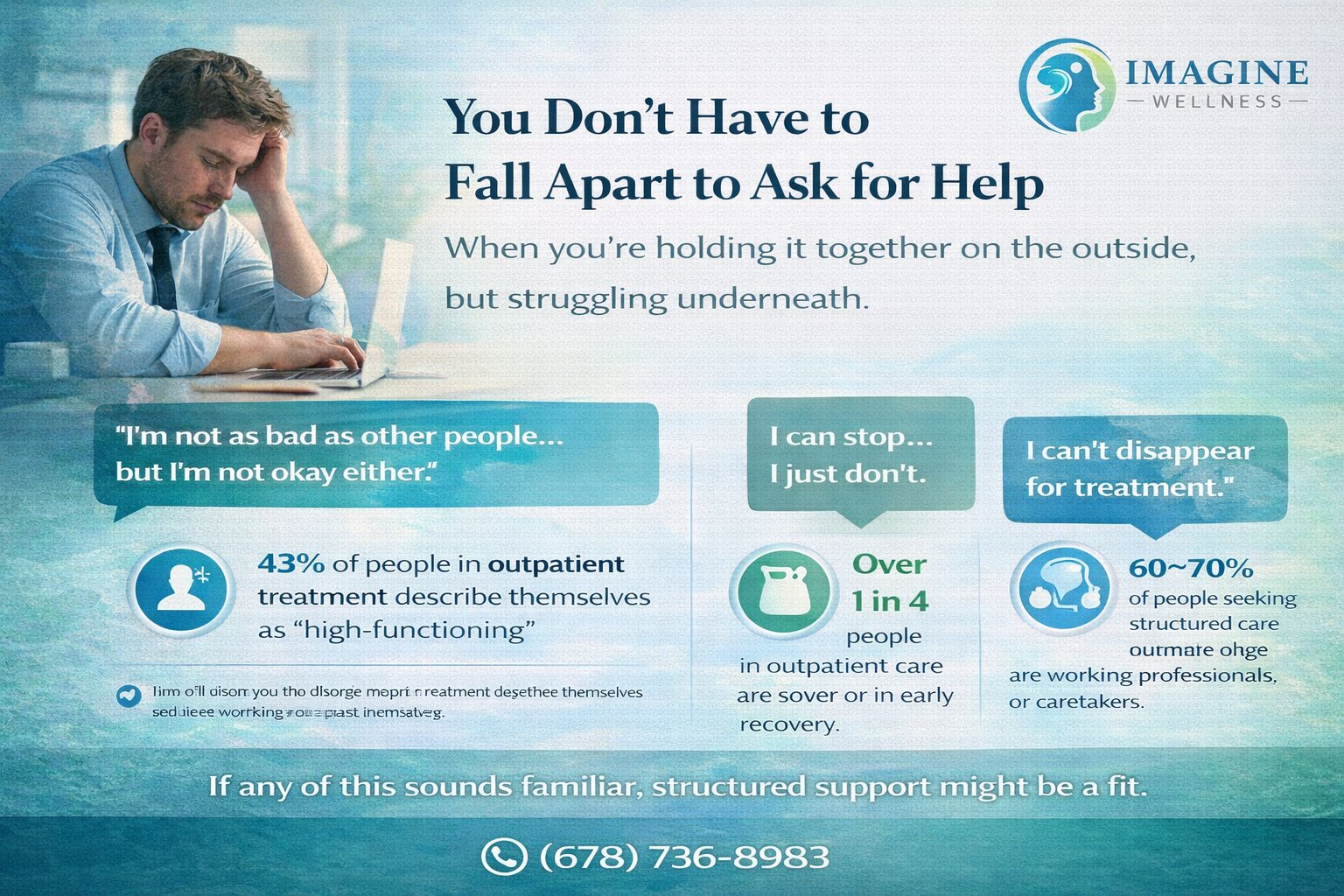
“I’m not as bad as other people… but I’m not okay either.”
This is often where the conversation begins.
There’s a quiet negotiation happening in your head.
You compare your situation to what you think “real” struggle looks like—and convince yourself you don’t qualify.
You’re still functioning. Still producing. Still showing up.
But something feels off.
Maybe it’s the constant mental noise.
Maybe it’s the way your mood shifts depending on whether you’ve had a drink or not.
Maybe it’s how much energy it takes just to maintain normal.
You don’t need to hit a visible breaking point to deserve support.
In fact, most people we work with never do.
“I can stop… I just don’t.”
This one comes with frustration.
Because part of you believes it’s still a choice.
And part of you knows it doesn’t feel like one anymore.
You’ve made promises—to yourself, to others.
Cut back. Take a break. Do better this week.
And sometimes, for a few days, you do.
But then something shifts. Stress builds. The day drags on.
And suddenly you’re back in the same pattern you were trying to avoid.
It’s not a lack of willpower.
It’s a lack of structure, support, and interruption in the cycle.
That’s where consistency—not intensity—starts to matter.
“I can’t disappear for treatment.”
This is one of the biggest barriers for high-functioning clients.
You have responsibilities that don’t pause.
Deadlines. Teams. Kids. A reputation you’ve built carefully over time.
The idea of stepping away completely can feel impossible—or even threatening.
So you keep going as you are, hoping things stabilize on their own.
But there’s another option.
Structured care that fits into your week—without requiring you to disappear from your life.
Care that meets you where you are, instead of asking you to abandon everything to get help.
“I just need something… more consistent.”
This moment is subtle, but important.
You’ve probably tried something already.
Maybe you’ve talked to someone occasionally.
Maybe you’ve tried to manage it on your own.
But it hasn’t been enough to create real change.
What you’re actually looking for isn’t more information.
It’s more consistency.
Support that shows up multiple times a week.
Conversations that build on each other.
Accountability that doesn’t fade after one session.
This is where an Intensive Outpatient Program IOP starts to make sense—not as a label, but as a rhythm.
A structure that holds you steady while things begin to shift.
“I don’t want this to get worse.”
Not everyone comes in because things have already fallen apart.
Many come in because they can see where things are heading.
You notice the patterns getting tighter.
The reliance increasing.
The recovery time getting longer.
There’s a quiet awareness: If nothing changes, this probably won’t stay manageable.
That awareness matters.
It’s often the difference between early intervention and waiting until things become harder to unwind.
“I’m tired.”
This is usually the most honest moment.
Not dramatic. Not emotional. Just… real.
Tired of thinking about it all the time.
Tired of managing appearances.
Tired of negotiating with yourself every day.
High-functioning doesn’t mean unaffected.
It often means carrying more than anyone realizes.
And eventually, that weight catches up.
What These Conversations Really Mean
None of these statements are about failure.
They’re about awareness.
About reaching a point where continuing the same way feels harder than considering something different.
High-functioning clients don’t need to be convinced they’re struggling.
They already know.
What they need is a way forward that respects their life, their responsibilities, and their reality.
That’s what structured, multi-day weekly care is built for.
Not to disrupt everything—but to support change within it.
FAQ: What High-Functioning Clients Often Ask Before Getting Started
Do I have to hit a breaking point before getting help?
No. Most people who start structured care are still functioning in their daily lives. You don’t need a crisis to take things seriously.
Will my insurance (like Blue Cross) cover care that meets multiple days a week?
Many insurance plans do offer coverage for structured outpatient care. Coverage depends on your specific plan, but our team can help verify benefits and explain what’s included—so you’re not guessing.
How do I fit treatment into a busy schedule?
Programs are designed with flexibility in mind. Many clients continue working, managing family responsibilities, and staying engaged in their daily lives while attending care several days a week.
Is this too much if I’m still “holding it together”?
Not at all. In fact, this level of care is often the right fit for people who don’t need round-the-clock support but need more than occasional check-ins.
What actually happens during sessions?
You’ll be part of structured group conversations, individual support, and skill-building sessions. The focus is on understanding patterns, building consistency, and creating real-life change—not just talking about problems.
What if I’m not sure I’m “ready”?
You don’t have to be 100% ready. Most people aren’t. You just need to be willing to explore whether something different might help.
Will people know I’m in treatment?
Confidentiality is taken seriously. Your participation is private, and many clients continue their routines without others knowing unless they choose to share.
You Don’t Have to Prove This Is “Bad Enough”
There’s no threshold you have to cross.
No moment where things officially become serious enough to deserve help.
If something in you is saying, this isn’t working anymore, that’s enough.
And if you’ve been quietly wondering whether something more consistent—something structured but manageable—could help, that’s worth listening to.
You don’t need to wait for things to fall apart to take yourself seriously.
If you’ve been asking these same questions, we’re here to help you sort through them. Call 678-736-8983 or explore your options through our treatment programs in Peach Tree to learn more about our Intensive Outpatient Program IOP services in Peach Tree, Georgia.