

If you’ve relapsed after 90 days, there’s a kind of silence that follows you around.
It’s not loud. It’s not dramatic.
It’s the kind that shows up in small moments:
- Sitting alone longer than usual
- Avoiding calls or messages
- Replaying the same thought over and over
“I really thought I had it this time.”
That thought hits differently when you had time built.
Because 90 days isn’t just time.
It’s effort.
It’s discipline.
It’s moments where you chose something different — again and again.
So when it slips, it doesn’t just feel like a mistake.
It feels like proof.
But it’s not.
And before anything else, you need to hear that.
A lot of people in this exact place don’t stay stuck — they reconnect with something more structured, like daytime treatment support, not because they failed, but because they realized they need more support for what comes next.
It Didn’t Fall Apart — It Slipped Under Pressure
It can feel like everything collapsed overnight.
But relapse usually isn’t one moment.
It’s pressure building quietly.
Maybe:
- Stress started stacking up
- You felt more alone than you expected
- Old thoughts came back stronger than you were ready for
And instead of a dramatic crash, it was a slow drift.
That matters.
Because a slow drift means there were moments where things could’ve gone differently — not because you did something wrong, but because you didn’t have enough support in those moments.
That’s not failure.
That’s a gap.
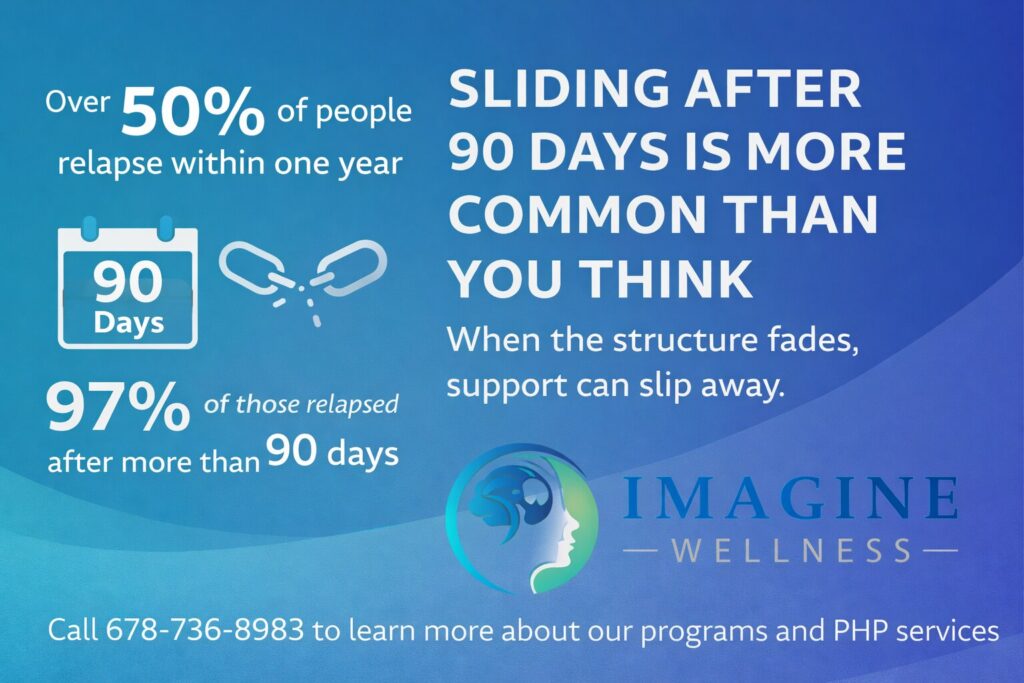
The Part No One Prepares You For After 90 Days
There’s something that happens around this time that people don’t talk about enough.
The structure fades.
In the beginning, everything is tighter:
- More check-ins
- More accountability
- More support built into your day
But after a few months, the expectation shifts.
You’re supposed to carry more on your own.
And that’s where things get tricky.
Because even if you’re doing well, your environment may not be stable enough yet to support that independence.
It’s like being asked to walk a tightrope without the net — not because you’re ready, but because it looks like you should be.
The Thought That Keeps People From Coming Back
This is where people get stuck.
Not in the relapse itself.
In what they tell themselves about it.
“I already messed this up.”
“They’re not going to take me seriously.”
“What’s the point of starting over?”
So instead of reaching out, they disappear.
They try to fix it alone.
They wait until it feels “bad enough” again.
But here’s the truth:
The longer you wait, the heavier it gets.
Not because you’re weak.
Because you’re carrying it without support.
You Didn’t Lose What You Built — You Lost Your Footing
This is a subtle but important difference.
You didn’t go back to who you were before.
You don’t unknow what you learned.
You don’t erase the awareness you gained.
You lost your footing.
That’s it.
And footing can be regained faster than people think — especially when you’re not trying to do it alone.
Why More Structure Can Feel Like Relief (Even If It Sounds Like “More”)
There’s a hesitation that comes up here.
“Do I really need more support?”
Because more can sound like:
- More time
- More effort
- More restriction
But for most people in this position, it feels like something else:
Relief.
Because instead of:
- Managing everything internally
- Fighting every urge alone
- Trying to “get back on track” by willpower
You have:
- Consistent support during the day
- A place where you don’t have to pretend you’re okay
- Structure that holds you up when your energy dips
It’s not about doing more.
It’s about carrying less by yourself.
The People Who Come Back After This Often Do It Differently
We’ve seen this over and over.
Someone builds time.
Something slips.
They feel like they’re back at the beginning.
But when they come back, something shifts.
They’re less focused on proving they can do it.
More focused on understanding what they need.
They:
- Ask for more support earlier
- Stay connected longer
- Stop trying to “power through” everything
And because of that, their next stretch feels different.
Not perfect.
But more stable.
More honest.
More sustainable.
This Is the Part Where It Can Go Either Way
Right now, you’re at a fork.
One path looks like:
- Staying quiet
- Trying to manage it yourself
- Waiting until things get worse
The other looks like:
- Reaching out sooner than you planned
- Letting someone meet you where you are
- Getting support before it feels urgent
Neither path requires perfection.
But one makes things heavier over time.
The other makes them lighter.
You’re Not Back at Day One — You’re at Day 91 With More Awareness
Your brain might try to reset everything.
Tell you it all starts over.
But that’s not true.
You’re at day 91 with:
- A clearer understanding of your triggers
- More honesty about what’s hard
- More awareness of what you actually need
That’s not nothing.
That’s progress.
Even now.
If you’re willing to take a step back toward support, you can explore options like programs, php services.
Frequently Asked Questions
Did I just throw away my 90 days?
No. Time in recovery doesn’t disappear. You still built awareness, discipline, and insight. That doesn’t reset just because you slipped.
Why does relapse feel worse after having time?
Because you had hope. You experienced what stability could feel like. So losing that — even temporarily — hits harder emotionally. That doesn’t mean you can’t get it back.
Do I have to start completely over?
Not in the way you think. You may restart certain routines, but you’re not starting from zero. You’re starting from experience. And that changes everything.
What if I’m too embarrassed to come back?
That feeling is more common than you think. But the people who support you aren’t looking for perfection — they’re looking for honesty. You don’t need a perfect explanation to return.
What actually helps after a relapse like this?
Consistency. Support that shows up more than once a week. Structure that helps you through the parts of the day that are hardest. That’s why many people benefit from more structured daytime care during this stage.
You’re Still Allowed to Come Back — Exactly Like This
Not fixed.
Not “back on track.”
Not with a perfect plan.
Just… like this.
Because this moment?
This is where a lot of real recovery actually begins.
Call 678-736-8983 or visit our page to learn more about our programs, php services in Atlanta, GA.