

There’s a version of you that fought hard to get stable.
You remember what it took to get there.
And then there’s this version — the one who feels… off again.
Not in crisis. Not unraveling.
But not fully connected either.
It’s subtle. Easy to ignore. Easy to explain away.
Until it isn’t.
If that’s where you are, you’re not failing. You’re not starting over.
You’re in a quieter phase of something that still deserves attention.
And this is exactly where staying connected matters most — especially for people continuing to manage conditions like bipolar disorder support.
Stability Isn’t Something You “Achieve” Once
There’s a common belief that once you reach stability, you’ve arrived.
That the hardest part is behind you.
But long-term mental health doesn’t stay still like that.
It moves.
Sometimes slowly. Sometimes without warning.
You might notice:
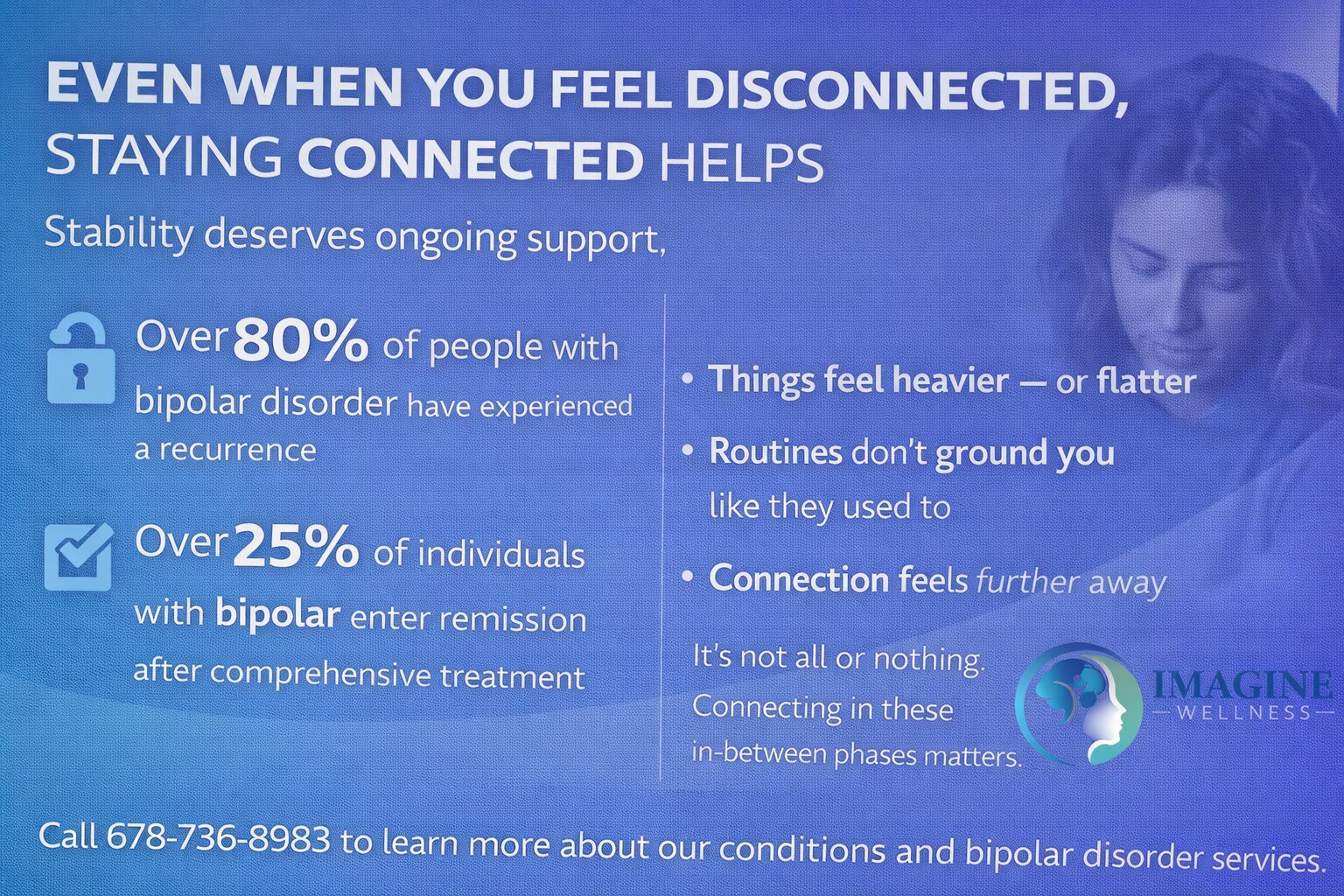
- The same routines don’t feel as grounding as they used to
- Your energy shifts in ways you can’t fully explain
- Things feel heavier — or flatter — than they did before
That doesn’t mean you’ve lost your progress.
It means your baseline is changing. And your support needs to change with it.
Feeling Disconnected Doesn’t Always Look Dramatic
This part catches a lot of people off guard.
Disconnection isn’t always loud or obvious.
Sometimes it looks like:
- Going through the motions without feeling much
- Skipping things that used to help, without a clear reason
- Feeling slightly out of sync with yourself
Nothing feels urgent enough to act on.
But something feels off enough that you notice.
That quiet in-between space is where people tend to drift — not crash.
The “I Should Be Fine By Now” Trap
This thought shows up for a lot of long-term alumni:
“I’ve done the work. Why does this still happen?”
It can feel frustrating. Even discouraging.
But here’s the truth we’ve seen over and over:
There isn’t a version of recovery where nothing ever shifts again.
There’s only a version where you learn how to respond when it does.
You’re not behind.
You’re just in a different phase of the same process.
Disconnection Often Starts With Small Decisions
It rarely happens all at once.
It’s usually a series of small, reasonable choices:
- “I’ll skip this week — I’m doing okay.”
- “I don’t really need to check in right now.”
- “I’ve got this.”
And for a while, you might.
Until those small gaps start to add up.
And suddenly, you realize you’ve been carrying everything alone again.
Not because you wanted to — but because it happened gradually.
Support Isn’t Just for Crisis — It’s for Calibration
One of the biggest shifts in long-term care is understanding this:
Support isn’t only for when things fall apart.
It’s for when things feel slightly off.
It’s for:
- Catching early changes before they grow
- Adjusting routines before they stop working
- Having a place to think out loud, without pressure
You don’t have to wait until something breaks to reconnect.
In fact, the earlier you reconnect, the easier things tend to feel.
The Work Evolves — And So Should Your Support
Early on, support might have been about getting through each day.
Now, it’s different.
Now it’s about:
- Noticing patterns before they become problems
- Understanding your own early warning signs
- Staying honest about what’s working — and what’s not anymore
That requires a different kind of support.
Less crisis-driven. More steady. More adaptive.
Sometimes that looks like returning to more structured care for a period of time.
Sometimes it’s simply reconnecting with consistent touchpoints.
Either way, it’s not a step backward.
It’s a way of staying aligned with where you are now.
You Don’t Have to Prove You’re “Okay”
There’s a quiet pressure many people carry after treatment.
To show that it worked.
To show that you’re fine now.
To not need help anymore.
But needing support doesn’t cancel out your progress.
It protects it.
You’re allowed to:
- Ask for help before things feel urgent
- Stay connected even when things feel manageable
- Revisit support without explaining or justifying it
You don’t have to earn your way back into care.
You’re already welcome.
Staying Connected Is What Keeps Things Steady
Most people don’t lose progress all at once.
It fades when connection fades.
Staying connected — even in small ways — creates:
- Awareness before things escalate
- A sense of accountability without pressure
- A steady place to land when things feel uncertain
Think of it less like “treatment” and more like maintenance.
You don’t wait for something to fall apart to take care of it.
We Expect Change — And We Plan for It
At Imagine Wellness Centers, we don’t expect you to stay the same version of stable forever.
That’s not realistic.
Life changes. Stress changes. You change.
So your support should be flexible enough to change with you.
Some people reconnect briefly to reset.
Some need more consistent structure for a period of time.
Some just need a place to check in and recalibrate.
All of it is valid.
If you’re noticing that quiet distance again, it’s not a failure.
It might just be a signal.
And signals are meant to be responded to — not ignored.
You can explore ongoing support options through our conditions, bipolar disorder services.
You’re Not Back at the Beginning — Even If It Feels That Way
It can feel like slipping.
Like you’re undoing everything you worked for.
But you’re not the same person you were at the start.
You have awareness now.
Language. Experience. Insight.
Even noticing that something feels off is a form of progress.
That awareness is what allows you to respond earlier this time.
Frequently Asked Questions
Is it normal to feel disconnected after being stable for a while?
Yes. This happens more often than people expect. Stability isn’t static. As life changes, your internal experience can shift too. Feeling off doesn’t mean you’ve lost progress — it often just means something needs adjustment.
How do I know if I need more support again?
You don’t need a major crisis to justify support. If you’re noticing changes in mood, energy, motivation, or connection — even if they feel mild — it’s worth checking in. Early support often prevents things from becoming more overwhelming later.
What if I feel like I should be able to handle this on my own?
That thought is very common. But handling everything alone isn’t a requirement for progress. In fact, staying connected to support is often what helps people maintain stability long-term.
Does going back to structured support mean I’m starting over?
No. It means you’re responding to what you need now. Returning to support — whether briefly or more consistently — is a continuation of your progress, not a reset.
What if I’m not in crisis — is it still okay to reach out?
Yes. Support isn’t only for crisis moments. It’s for staying steady, adjusting to change, and having a place to process things before they build up.
You Don’t Have to Drift Away to Prove You’re Okay
You don’t have to wait until things feel unmanageable.
You don’t have to prove that you’re “fine enough” to stay on your own.
Staying connected is what helps you stay steady.
And you deserve that — at every stage.
Call 678-736-8983 or visit our page to learn more about our conditions, bipolar disorder services in Atlanta, GA.