
From the outside, everything still looked “normal.” I wasn’t missing work. I showed up to family events. I wasn’t slurring my words or crashing cars. But I was lying. Constantly.
Lying by omission. Lying with a smile. Lying when I said I had just one. Lying when I said I had it under control.
And the first place I stopped lying wasn’t a crisis center or rehab. It was an intensive outpatient program.
I Was Too Functional to Feel “Sick Enough”
When I first started googling treatment options, I filtered out anything that felt dramatic. Inpatient? Not for me. Detox? I wasn’t shaking. Residential treatment? I had meetings, deadlines, a mortgage.
Part of me was looking for permission to stay in denial. If I could find a level of care that didn’t require my whole life to pause, maybe I could still convince myself I wasn’t really struggling.
But here’s the truth: High-functioning doesn’t mean healthy. It just means your collapse is happening behind the scenes.
The Exhaustion Was the First Symptom I Couldn’t Ignore
I used to think I was just tired. Who isn’t?
But eventually, that tired turned into dread. I wasn’t just running on empty—I was emotionally bankrupt. My ability to “push through” started failing me. And when the smallest things—like a client email or my kid asking for help with homework—made me snap, I realized I wasn’t tired.
I was depleted. And hiding it was killing me.
That’s when I found Imagine intensive outpatient program. Not in a dramatic moment. Just after one more night of drinking and hating myself for it.
Group Was the First Room I Didn’t Perform In
I remember my first IOP group vividly. I had rehearsed my story in my head like a TED Talk—carefully curated to sound self-aware but not messy. I wanted to look like someone who had this under control. Someone just here for a “tune-up.”
But then someone else spoke.
They talked about overachieving to avoid feeling. About parenting while numbing. About hiding in plain sight.
And suddenly, my curated speech felt ridiculous.
So instead, I just said: “I’m really tired of trying to look fine when I’m not.”
It wasn’t profound. But it was the most honest thing I’d said in months.
The Structure of IOP Gave Me Space to Breathe
What I didn’t expect was how much the structure of IOP helped me stop spiraling.
I still lived at home. I still worked. But three to four times a week, I stepped into a space that wasn’t about pretending.
There was accountability—but it didn’t feel punishing. There were worksheets—but they weren’t busywork. There were people—but they weren’t judging.
Instead of spending energy hiding, I started spending energy healing.
IOP Helped Me Name What I’d Been Avoiding
In traditional therapy, I always played it safe. I told the truth—but only the digestible parts.
In IOP, I didn’t have the energy to keep curating. And when someone gently challenged me—“What are you not saying right now?”—it cracked something open.
I said things like:
- “Sometimes I drink because I don’t want to feel boring.”
- “I’m scared that if I stop using, I’ll lose the part of me that’s fun.”
- “I feel like a fraud at work and at home.”
And every time I said something like that, the world didn’t end.
It actually started to feel a little more manageable.
The Lie That Nearly Broke Me
The biggest lie I told wasn’t to my spouse, my coworkers, or my therapist.
It was to myself: “This isn’t that bad.”
But “not that bad” still means not good. “Not an addict” still means not free. “Not rock bottom” still means stuck.
IOP didn’t require me to identify with every label. It just asked me to be honest. And that honesty changed everything.
What I Found on the Other Side of Honesty
I didn’t magically become someone who never lies. I still catch myself sugarcoating and performing.
But now, I know what it feels like to speak from my gut instead of my image. And once you’ve felt that kind of relief, you don’t want to go back.
IOP didn’t fix me.
It just gave me the space to face myself—and that was the real starting line.
Could an Intensive Outpatient Program Help You?
If you’re keeping everything “together” but falling apart inside, you’re not alone. And you’re not beyond help.
You might not need to burn your life down to rebuild it. You might just need a space where honesty isn’t punished. Where your pain isn’t minimized because your resume looks good. Where your story doesn’t have to sound like a Lifetime movie to be taken seriously.
Imagine Wellness Centers offers that kind of space. One that respects your life and your struggle.
FAQ: Intensive Outpatient Programs and High-Functioning Addiction
What is an intensive outpatient program (IOP)?
An IOP is a structured, non-residential treatment program that includes therapy, group sessions, and recovery education. It’s designed for people who need more than weekly therapy but don’t require 24/7 care.
How is IOP different from inpatient treatment?
Inpatient programs require you to live on-site full-time. IOP allows you to continue living at home, working, and fulfilling daily responsibilities while receiving care several times per week.
Is IOP only for people with “serious” addictions?
No. IOP is designed for a range of needs. If your substance use is interfering with your emotional well-being, relationships, or sense of control—even subtly—you may benefit from IOP.
Will I have to talk in group?
You’ll be encouraged, but not forced. Many people feel hesitant at first. But group often becomes the most validating part of the process.
Can I keep working while in IOP?
Yes. Most IOPs are built with working adults in mind. Evening sessions and flexible scheduling help you balance treatment with work and family life.
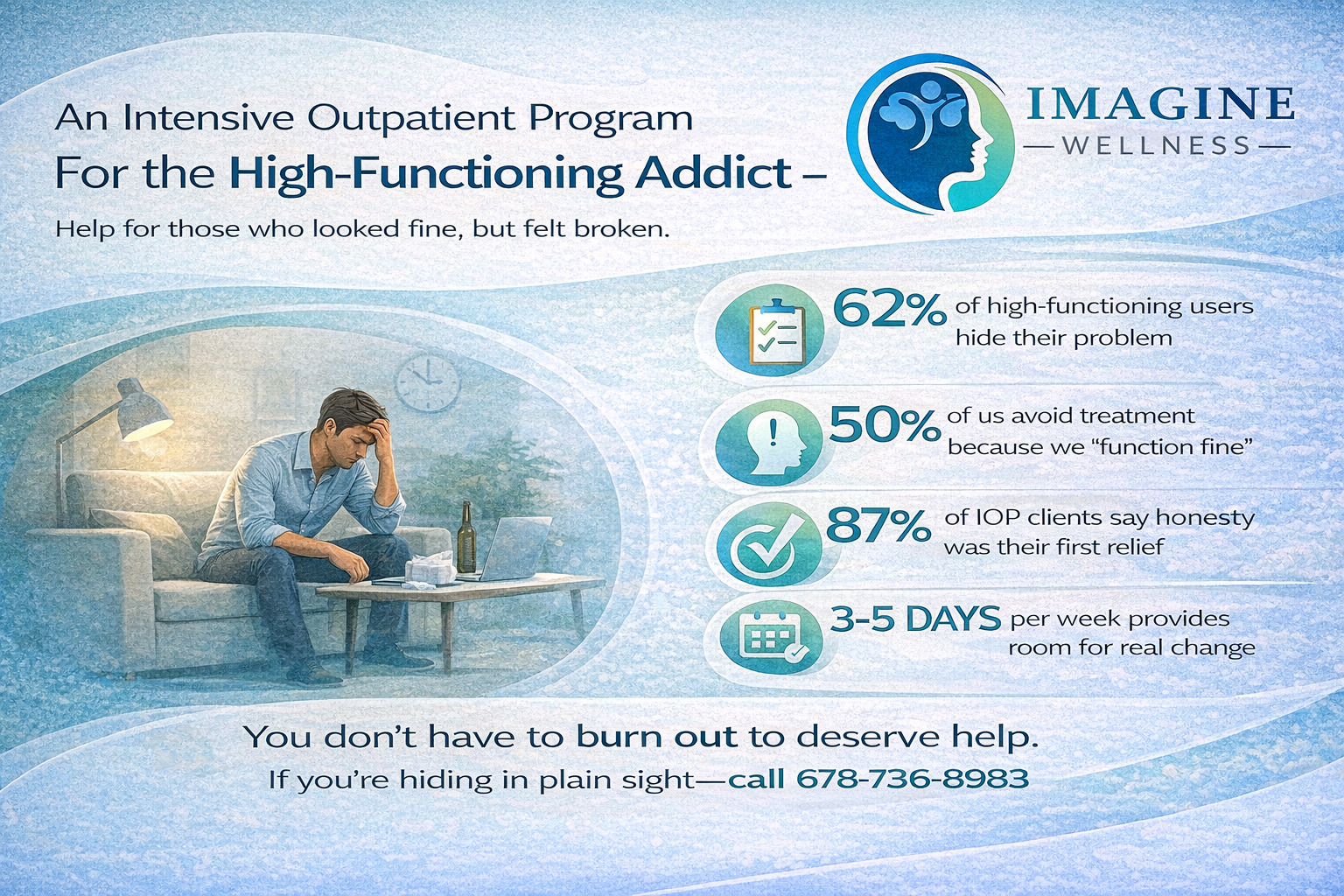
You Don’t Have to Burn Out to Deserve Help
If you’re tired of hiding, tired of performing, tired of saying “I’m fine” when you’re not—there’s another way.
📞 Call 678-736-8983 or visit Imagine Wellness Centers to learn more about our intensive outpatient program services in Atlanta, GA.
You don’t have to be broken to begin. You just have to be honest.