
When your 20-year-old starts using again, the fear comes fast and quiet. Maybe it’s missed classes. Maybe it’s the way they avoid your eyes. You don’t want to assume the worst—but you know what it looks like. And what it costs.
You’re not overreacting. And no, you didn’t fail.
A partial hospitalization program (PHP) can meet your child—and your family—in this moment of “not again.” It’s not a restart. It’s a recalibration. And sometimes, it’s the one thing that interrupts the slide before it becomes a fall.
At Imagine Wellness Centers, our PHP services are designed for this exact stage: the in-between. When things aren’t yet catastrophic, but you’re deeply afraid they could be. This blog is here to help you understand what PHP is, when it matters, and why it just might be the right next step.
What Is a Partial Hospitalization Program?
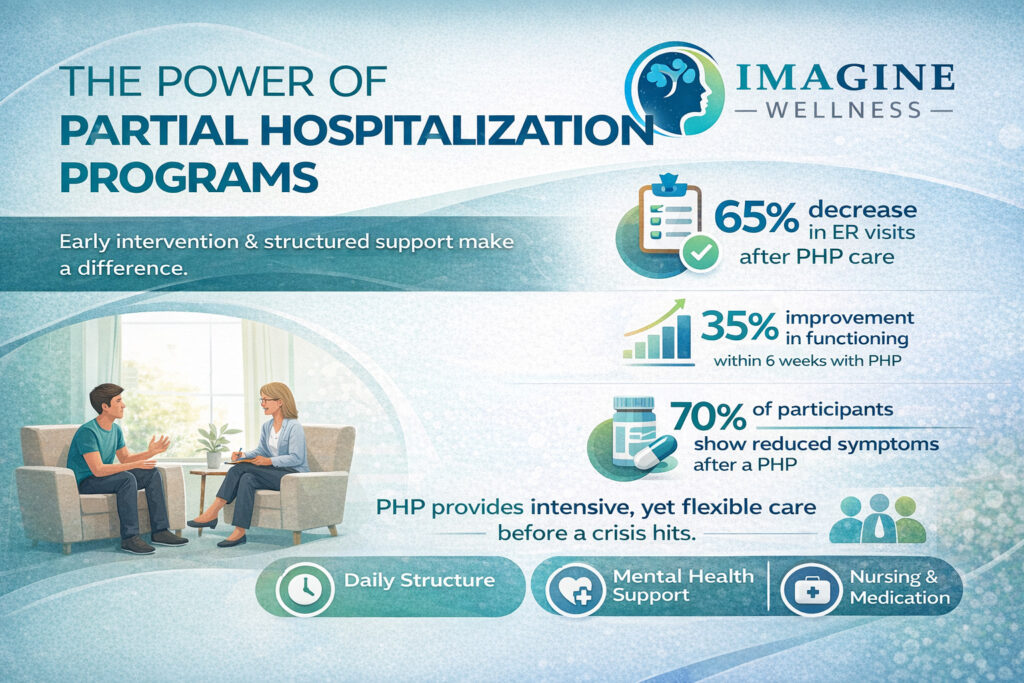
A partial hospitalization program offers intensive behavioral health support during the day while allowing clients to return home in the evening. It’s structured, therapeutic, and often serves as a bridge between inpatient care and standard outpatient therapy.
Think of PHP as a “middle path”—not residential, but far more robust than once-a-week therapy.
Here’s what PHP typically includes:
- Clinical programming 5–6 hours a day, 5 days a week
- Individual and group therapy
- Psychiatric care, including medication management
- Skills-based sessions (e.g., emotional regulation, relapse prevention, trauma work)
- Family involvement and psychoeducation
- Coordination with outside providers or schools, when appropriate
It’s not about locking your child away—it’s about surrounding them with support while they still have one foot in the real world.
When Is PHP the Right Fit?
Families often wait until a crisis demands hospitalization. But PHP can intervene before that happens.
Signs PHP may be appropriate:
- Your young adult is withdrawing, lying, or acting erratically
- They recently relapsed or resumed risky substance use
- They’re refusing to attend school or work
- Depression or anxiety symptoms have intensified
- Past treatment didn’t stick—and you want to try something different
- You’re walking on eggshells, afraid to bring up anything too real
Even if they’re still functioning “okay” on the surface, you know when the ground is starting to shift underneath. PHP is for that moment.
Why PHP Works When “Trying Again” Feels Hopeless
When families come to us, they’re often exhausted. Hope feels dangerous. You’ve done this before. You’ve paid for treatment. You’ve had hard conversations. You might be thinking:
“If it didn’t work the first time, why would this be different?”
Because treatment isn’t one-size-fits-all. And because readiness, support, and timing matter more than people think.
PHP works because it:
- Provides daily consistency in a world that’s felt chaotic
- Targets underlying issues, not just behaviors
- Engages family systems rather than isolating the problem in one person
- Builds momentum, not dependency
It also keeps your young adult connected to their everyday world. That means the skills they learn are practiced immediately—not someday, in a different setting, when they return “home.”
What Parents Need to Hear (But Aren’t Often Told)
Here’s what we tell parents behind closed doors—the things they wish someone had said sooner:
- Your love didn’t cause this. You didn’t make your child relapse. Love is not a liability.
- You’re not supposed to fix this alone. Trying to do so often delays the help that actually works.
- It’s okay to feel angry and tired. Love and burnout coexist more often than we admit.
- PHP is not “failure.” It’s smart, proactive care—and it shows your child you still believe they’re worth helping.
You’re not starting over. You’re starting from experience. That matters.
What to Expect in Our PHP at Imagine Wellness Centers
At Imagine Wellness Centers, we tailor our PHP model to support both the client and the family system. Our clinicians bring deep experience, trauma-informed care, and a commitment to dignity-first support.
Here’s what that looks like day-to-day:
- Mornings and afternoons: Clients participate in group therapy, skill-building sessions, and individualized support
- Mid-day psychiatric consults: For those needing medication assessment or adjustment
- Family integration: Regular sessions help rebuild communication, set boundaries, and reset expectations
- Transitions: When clinically appropriate, clients step down into our intensive outpatient program to maintain progress
Every piece is designed to hold your child accountable and hold them with compassion.
What Happens After PHP?
Recovery doesn’t stop with PHP. It evolves.
Some clients continue into intensive outpatient care. Others resume therapy and stabilize in school or work. The point is: PHP isn’t forever. It’s a launchpad—not a landing place.
And you won’t be left wondering what’s next. Discharge planning starts early, and our team walks with you the entire way.
Location-Based Care That Feels Close to Home
We offer partial hospitalization program services in Atlanta, GA. If your young adult needs help, they won’t have to go far—or go it alone. Our programs are local, accessible, and rooted in the community.
📍 See our treatment options in your area.
Frequently Asked Questions About PHP
How is PHP different from inpatient treatment?
Inpatient programs require clients to live at the facility 24/7. PHP allows them to receive intensive support during the day and return home each evening. It’s a good fit for those who need structure but don’t require hospitalization.
Will I be involved as a parent?
Yes. We integrate family therapy and education into PHP. You’ll have opportunities to speak with clinicians, ask questions, and learn how to support your child in healthy, sustainable ways.
Does PHP address both mental health and substance use?
Absolutely. We understand how intertwined these issues are. Our PHP is equipped to support co-occurring disorders through an integrated approach.
What if my child doesn’t want to go?
Resistance is common. Our admissions team can help you strategize the conversation and offer a clinical assessment. Sometimes, hearing from a neutral professional makes all the difference.
How long does PHP last?
The average length is 2–6 weeks, depending on clinical need. Our team evaluates progress weekly and collaborates with the family on next steps.
📞 Ready to Talk?
If you’re seeing the signs, trust your gut—and let us help. Call 678-736-8983 or visit our PHP page to learn more about our partial hospitalization program services in Atlanta, GA.
You don’t have to wait for things to get worse. You can act now—gently, clearly, and with expert support behind you.